
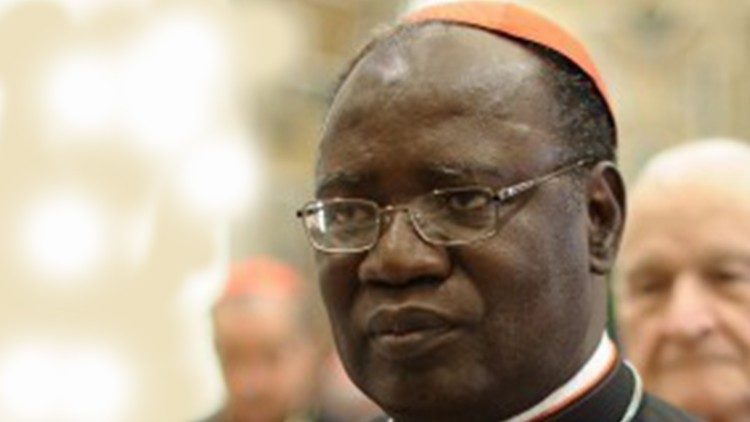

DAR ES SALAAM: POLYCARP Cardinal Pengo, who died on February 19, 2026 at the age of 81, was one of the most influential Catholic leaders in Tanzania’s modern history, serving for nearly three decades as Archbishop of Dar es Salaam and representing the country at the highest levels of the global Church.
His death was announced by Dar es Salaam Archbishop Jude Thaddaeus Ruwa’ichi, who said Cardinal Pengo passed away at 10:00 p.m. while receiving treatment at the Jakaya Kikwete Cardiac Institute (JKCI) in Dar es Salaam.
Born on August 5, 1944, at Mwazye, Mbinga District in southern Tanzania, Pengo pursued priestly formation at a time when the Catholic Church in Tanzania was expanding rapidly in both membership and institutional presence. He was ordained to the priesthood on June 20, 1971.
\His early ministry included service as Secretary to the Bishop of the Diocese of Sumbawanga from 1971 to 1973. He was later sent to Rome for further studies, where he specialised in Moral Theology at the Pontifical Lateran University’s Alphonsianum Faculty between 1973 and 1977.
Upon returning to Tanzania, he was appointed to teach Moral Theology at Kipalapala Major Seminary in the Archdiocese of Tabora. From 1978 to 1983, he served as Rector and was among the founding leaders of Segerea Major Seminary in Dar es Salaam, an institution that became central to priestly formation in the country. His episcopal career began on November 11, 1983, when Pope John Paul II appointed him Bishop of Nachingwea Diocese. He was consecrated bishop on January 6, 1984, at St Peter’s Basilica in the Vatican by Pope John Paul II, becoming one of the Tanzanian bishops ordained by the pontiff for service within the country. Cardinal Pengo was formally installed in Nachingwea in February 1984 before being transferred on October 17, 1986, to lead the Diocese of Tunduru–Masasi. He was installed there on February 12, 1987.
In January 1990, Pope John Paul II appointed him Coadjutor Archbishop of Dar es Salaam with the right of succession. He assumed full leadership of the archdiocese on February 12, 1992, beginning a tenure that would last 27 years.
In February 1999, he was created Cardinal by Pope John Paul II, becoming Tanzania’s second Cardinal after Cardinal Laurian Rugambwa. His elevation placed him among the senior clergy eligible to participate in papal conclaves.
Cardinal Pengo took part in the 2005 conclave that elected Pope Benedict XVI and later in the March 2013 conclave that elected Pope Francis.
His participation positioned him as one of the Tanzanian Church’s key links to the Vatican during two historic transitions in global Catholic leadership.
Beyond Tanzania, he served from 2007 to 2009 as President of the Symposium of Episcopal Conferences of Africa and Madagascar (SECAM), contributing to coordination and dialogue among Catholic bishops across the continent.
In April 1994, he participated in the First African Synod of Bishops, a gathering that examined the role of the Church in African societies and addressed pastoral and social challenges facing the continent. Throughout his ministry, Cardinal Pengo emphasised priestly formation and theological education.
He supported the strengthening of seminaries and encouraged the involvement of lay Catholic associations, including the Catholic Women of Tanzania (WAWATA) in supporting priestly training institutions. During his time as Archbishop of Dar es Salaam, the archdiocese experienced growth in clergy numbers, parishes and institutional presence.
His leadership coincided with significant social and political changes in Tanzania, during which he often contributed to national conversations on moral and social issues.
He formally retired on August 15, 2019, after Pope Francis accepted his resignation upon reaching the canonical retirement age. He was succeeded by Archbishop Ruwa’ichi.
Cardinal Pengo’s life in priesthood and episcopal service spanned more than five decades, during which he became a prominent religious figure in Tanzania and a representative of the country within the wider Catholic Church.