
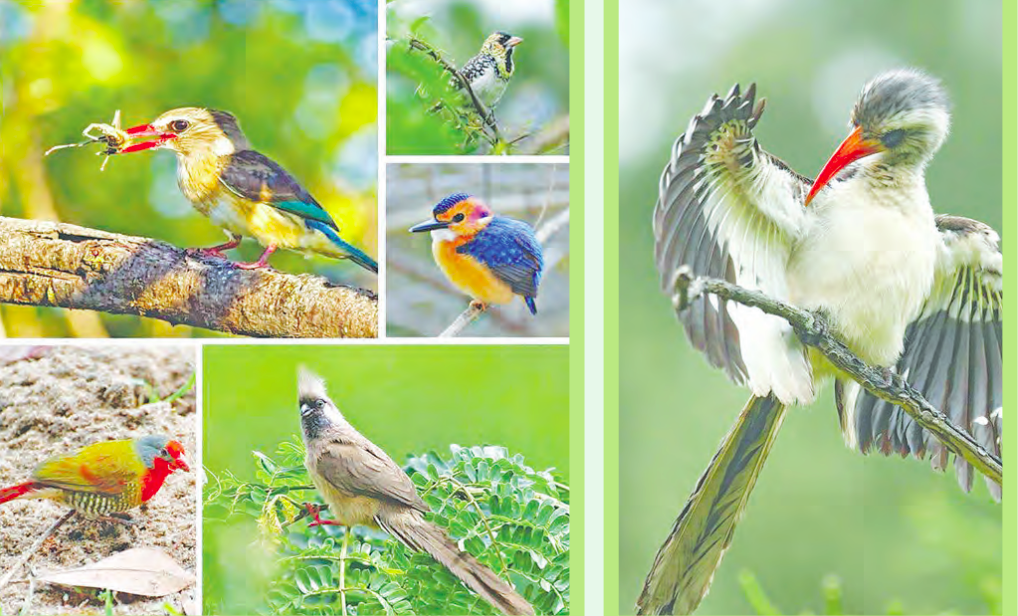

KISARAWE: ALTHOUGH globalisation has made the world seem like a single village bringing people closer and making communication easier, human beings still require a passport to travel from one country to another.
In contrast, animals and birds traverse thousands of kilometres, crossing borders and even continents without restriction, guided solely by the rhythms of nature and the demands of survival.
A striking example of this natural wonder can be found in the Pugu Kazimzumbwi Nature Forest Reserve located about 20 kilometres south-east of Dar es Salaam in Kisarawe District, Coast Region.
Within this indigenous forest reserve, one of the most fascinating seasonal visitors is the European Bee-eater.
According to tour guide Eliud Mwakijabila, the European Bee-eater is among the bird species that migrate from one continent to another.
It breeds in southern and central Europe and parts of western Asia, while populations also occur in northern and southern Africa.
With the exception of those resident in southern Africa, most migrate seasonally and spend the northern winter in tropical Africa.
Besides these intercontinental migrants, there are also birds that undertake intra-African migration, moving between countries within the continent in response to seasonal changes and food availability.
Another seasonal visitor to the reserve is the African Pitta, which appears during its migratory period.
Mr Mwakijabila said the European Bee-eaters feed primarily on insects, particularly bees, hence their name.
The principal reason for their long journeys is the search for adequate food supplies, alongside adapting to seasonal weather changes and preparing for breeding.
He said that during the breeding season, they require abundant food, favourable weather conditions and safe habitats where nourishment is readily available.
“When faced with harsh winters or environments covered in ice and snow, they are compelled to relocate to regions with warmer climates and more reliable food sources,”he said.
One might wonder how such small creatures manage to travel thousands of kilometres without succumbing to exhaustion.
Mr Mwakijabila explained that before embarking on migration, these birds feed intensively to accumulate fat reserves, especially around the breast and flanks.
ALSO READ: Domestic tourism heightens Kazimzumbwe Reserve as it generates 1.9bn/- in revenue
These stored fats serve as their primary source of energy throughout the journey, enabling them to sustain prolonged flights across vast distances.
At Pugu Kazimzumbwi Nature Forest Reserve, the birds are commonly observed between October and December, a period that coincides with their breeding season.
Their presence is not only a draw for visitors but also of considerable ecological importance.
They help regulate insect populations and contribute to pollination processes, therefore maintaining ecological balance. For instance, Mr Mwakijabila explained, certain tree species depend on highly specialised pollinators.
One example is the Sycamore fig, which relies on a specific wasp from the Fig wasp family for pollination.
“No other insect can perform this function, illustrating the intricate interdependence that sustains natural ecosystems.”
To better understand migratory routes and origins, he said ornithologists fit selected
birds with tracking devices. This technology enables researchers to determine where the birds have travelled, the routes they have taken and their eventual destinations.
As a result, Pugu Kazimzumbwi has become an important site for scientific study, attracting universities, research institutions and independent scholars whose findings contribute to broader knowledge and sustainable development.
Beyond its scientific and ecological significance, the reserve supports a rich diversity of bird species, making birdwatching a particularly rewarding activity within the reserve.
This form of eco-tourism offers numerous benefits, gentle physical exercise, mental refreshment and valuable educational opportunities.
Observing birds in their natural habitat, their behaviour, migration patterns and interaction with the environment, provides a living classroom for students, researchers and nature enthusiasts alike.
In a world where humans must carry passports to cross borders, migratory birds remind us that nature recognises no such boundaries.
For them, the planet remains an open expanse defined not by political lines, but by seasons, survival and the enduring cycle of life.
According to tour guides, the forest is also a home to a wide variety of bird species, many of which are unique in both behaviour and habitat.
This makes Pugu Kazimzumbwi an excellent destination for birdwatching, an activity that is most popular in the early morning hours when birds awaken and begin foraging.
Among other bird species found in the reserve is the East Coast akalat, commonly seen along the Eastern Coastal region, including Tanga, Dar es Salaam, Zanzibar and Pugu Kazimzumbwi.
Another notable species is the Four-coloured Bushshrike, a favourite among visitors due to its striking appearance.
This bird displays a blend of four colours green, red, black and yellow and is undoubtedly one of the many natural wonders that visitors will want to add to their list of memorable experiences when exploring the Pugu Kazimzumbwi Nature Forest Reserve.