
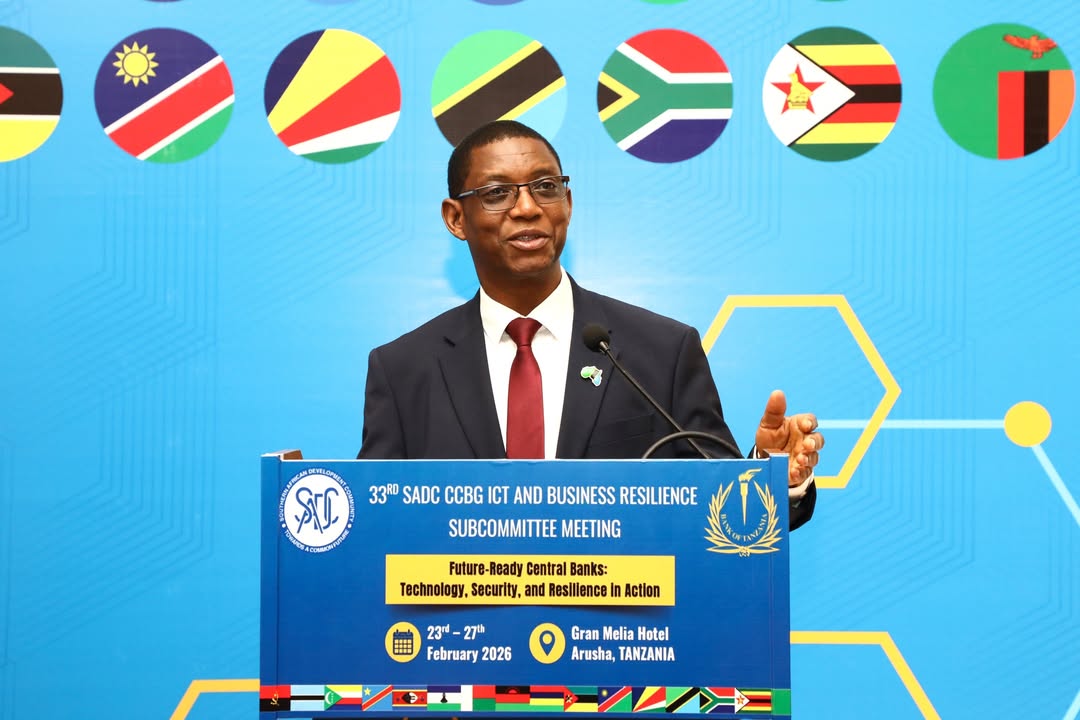

ZANZIBAR: “RECENT global shocks have tested the resilience of our financial systems.”
With that cautionary note, Bank of Tanzania Governor Emmanuel Tutuba opened high-level deliberations of central bank governors and financial regulators from across Sub-Saharan Africa, gathered in Zanzibar to confront emerging risks facing the region’s financial systems.
The Financial Stability Board (FSB) Regional Consultative Group for SubSaharan Africa (RCG-SSA) meeting, hosted by the Bank of Tanzania, took place on February 20, 2026, at ‘The Mora luxury Hotel’ in Unguja North Region.
The forum brought together Governors, Deputy Governors and senior officials from central banks and regulatory authorities across the region. At a time of heightened global uncertainty, the discussions in Zanzibar carried unusual weight.
A Region Under Pressure Sub-Saharan Africa’s financial systems are navigating a complex web of global and domestic pressures. Geopolitical tensions, climate-related risks, policy uncertainty and the lingering after-effects of the Covid -19 pandemic have combined to fuel inflation, strain public finances and trigger exchange rate volatility in many emerging economies.
“These dynamics have constrained fiscal space and complicated the attainment of fiscal targets,” Governor Tutuba noted, underscoring the urgency of coordinated regional responses.
The Financial Stability Board, established by the G20 in 2009 following the global financial crisis, plays a central role in promoting international financial stability.
Through its Regional Consultative Group for SubSaharan Africa, the FSB provides a platform for African policymakers to exchange experiences, assess vulnerabilities and contribute to global regulatory reforms.
Participants in the Zanzibar meeting included central banks from South Africa, Zambia, Kenya, Ghana, Nigeria, Botswana, Angola, Uganda, Namibia and Mauritius, alongside regional institutions such as the Bank of Central African States (BEAC) and the Central Bank of West African States (BCEAO).
Debt, Non-Bank Finance and Artificial Intelligence Among the key issues on the agenda were debt sustainability, vulnerabilities in non-bank financial intermediaries, and the rapid evolution of financial technologies — particularly Artificial Intelligence (AI), FinTech and crypto-assets.
Across the continent, digital innovation is reshaping the financial landscape. Mobile money platforms and digital banking have significantly expanded financial inclusion. However, these advances also introduce regulatory complexity and cybersecurity risks.
“While these innovations hold promise for enhancing financial inclusion and efficiency, they also present regulatory and cybersecurity challenges,” Governor Tutuba warned.
“Our collective commitment to safeguarding monetary and financial stability, while fostering sustainable economic growth, is paramount.”
ALSO READ: EAC tasks BoT to educate bloc’s central banks on gold purchasing program
Co-Chair of the RCGSSA and Governor of the South African Reserve Bank, Mr Lesetja Kganyago, emphasised that no country can address these risks in isolation. “Financial stability is a shared responsibility,” Kganyago said.
“Global spillovers affect us all. Strengthening cooperation, sharing data and implementing sound supervisory standards are critical to ensuring resilience in our financial systems.”
Similarly, Co-Chair of the RCG-SSA and Governor of the Bank of Zambia, Mr Denny Kalyalya, stressed the importance of prudent debt management and forward-looking regulation.
“Debt sustainability and financial sector stability go hand in hand,” Kalyalya noted.
“Strengthening crisis preparedness and supervisory oversight is essential if we are to support long-term economic growth.”
Tanzania’s Steady Performance While acknowledging regional and global risks, Governor Tutuba highlighted Tanzania’s relatively strong macroeconomic performance.
In 2025, economic growth is estimated at 6 per cent for Mainland Tanzania and 6.8 per cent for Zanzibar. Projections for 2026 place growth at 6.3 per cent for the mainland and 7.2 per cent for Zanzibar.
The expansion has been driven by improved agricultural productivity, reliable electricity supply, favourable business conditions, rising exports, particularly gold and coffee — and strong tourism recovery.
“Inflation has remained within the country’s medium-term target range of 3–5 per cent,” BoT Governor said.
In the second half of 2025, inflation fluctuated between 3.1 and 3.6 per cent on the mainland, while Zanzibar averaged 3.7 per cent. Prudent monetary policy, stable food prices and exchange rate stability have helped anchor price levels.
He explained further that the external sector has also improved, and the current account deficit narrowed to 2.2 per cent of GDP in 2025, its lowest level in five years, supported by export growth and lower global oil prices.
Zanzibar, meanwhile, sustained a current account surplus, largely driven by tourism earnings.
The financial sector remains resilient. Non-performing loans declined to 2.8 per cent at the end of December 2025, below the 5 per cent tolerable threshold.
Banks are well-capitalised, maintain adequate liquidity buffers and continue expanding credit to the private sector, which grew by 17.6 per cent.
As an FSB member, the Bank of Tanzania has implemented key reforms, including frameworks for identifying Domestic Systemically Important Banks (DSIBs), climate-related risk assessments, emergency liquidity assistance mechanisms, and regulatory guidelines for crypto-assets, cybersecurity and non-bank financial institutions, Mr Tutuba explained.
Preparing for Future Risks Despite positive indicators, risks remain. Climate change poses operational and credit risks to financial institutions.
Cyber threats are becoming increasingly sophisticated. Uncertainty surrounding global trade policies may dampen investment flows and disrupt supply chains. The 2026 FSB work programme reflects these emerging realities.
It includes strengthening oversight of private credit markets, monitoring vulnerabilities in stable coins, developing best practices for AI adoption in finance, and improving cross-border payments efficiency.
As discussions concluded in Zanzibar, Governor Tutuba reminded delegates that financial stability ultimately serves a broader purpose.
“We have not only come to discuss financial sector stability,” he said, inviting participants to experience Zanzibar’s culture and hospitality.
“May our deliberations strengthen our collective resolve to build resilient, inclusive and stable financial systems across Sub-Saharan Africa.”
In a world marked by volatility and rapid technological change, the message from Zanzibar was clear: resilience must be built deliberately — through cooperation, sound regulation and shared commitment to stability.