

IN 2025, Kazakhstan reached a new milestone in its digital development by exporting IT services valued at over $1 billion, reflecting the country’s rapid progress in technology and digitalization.
This achievement underscores Kazakhstan’s strategic focus on transforming into a fully digital state, a vision championed by President KassymJomart Tokayev.
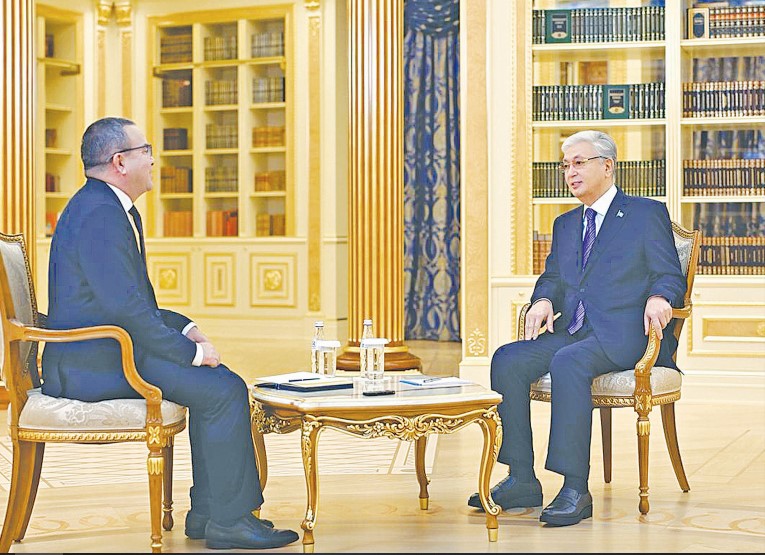
Speaking in his annual interview, the President highlighted that Kazakhstan’s economic growth exceeded 6 percent last year, with GDP surpassing $300 billion and GDP per capita reaching $15,000 – a record for the region.
This growth has been supported by the country’s accelerated adoption of digital technologies and innovative IT solutions. President Tokayev emphasized that digitalization is not merely a technological initiative but a strategic tool for the nation’s development.
In particular, the expansion of digital platforms and artificial intelligence (AI) applications is improving the efficiency of public services, enabling better resource allocation, and increasing transparency in government operations.
These tools are also helping monitor agricultural production, forecast yields, and reduce regional disparities by improving living standards in rural areas. A major step in institutionalizing Kazakhstan’s digital agenda was the establishment of the Ministry of Artificial Intelligence and Digital Development.
This ministry was formed on the basis of the former Ministry of Digital Development and Aerospace Planning and now coordinates the country’s AI and digitalization initiatives, ensuring that technological modernization is implemented systematically across all sectors.
Over the past years, significant infrastructural groundwork has been laid to support digitalization across Kazakhstan. Thousands of rural schools now have high-speed Internet, digital services are increasingly accessible, and rural districts are becoming more selfsufficient.
These advances facilitate the introduction of modern solutions in sectors ranging from agriculture to education, creating equal opportunities for urban and rural populations alike. Kazakhstan’s approach to digitalization is aligned with global technological trends.
While the country does not aim for global dominance, it is determined not to lag behind in the international knowledge economy. Accelerated modernization ensures that Kazakhstan remains competitive and resilient amid rapid technological change, safeguarding its long-term development and economic stability.
The export of $1 billion in IT services reflects the tangible results of these policies, showcasing Kazakhstan’s growing presence in the global digital market.
As digital transformation continues to be a national priority, and with the support of the newly established Ministry of Artificial Intelligence and Digital Development, the country is poised to expand its technological footprint while improving the quality of life for its citizens. In a related development, President Kassym-Jomart Tokayev outlined Kazakhstan’s strategic development priorities in an extensive interview with Turkistan newspaper on January 5, 2026.
ALSO READ: Itracom Fertilizers Company generates 1.29bn/- in revenue through its plant in Babati
The head of state declared: “Kazakhstan has entered a new stage of modernisation”. The discussion covered economic achievements, digital transformation, strategic resources, political reforms, and social priorities. The President reviewed last year’s results, highlighting substantial progress: “Our economy grew by more than 6 per cent, GDP exceeded $300 billion, and GDP per capita surpassed $15,000”.
These “record figures not only for our country, but for the entire region” demonstrate sustained growth. Tokayev emphasized the “irreversibility of reforms,” stating: “Kazakhstan took a major step forward on the path of modernisation”. Declaring 2026 the “Year of Digitalisation and Artificial Intelligence,” Tokayev pointed to Kazakhstan’s solid foundation: “Astana Hub innovation cluster brings together two thousand companies,” with “total exports of IT services in 2025 amounted to approximately one billion US dollars”.
Key achievements include “two supercomputers – Alem.Cloud and Al-Farabium,” AI-Sana program training for over 650,000 students, and plans for a “specialised, researchfocused AI university.” Upcoming projects feature the “pilot CryptoCity zone for digital assets” and “accelerated-development city of Alatau.” The Artificial Intelligence Development Council launched in May 2025, the AI Law was signed in November, and a Ministry of Artificial Intelligence and Digital Development established.
The President affirmed: “Kazakhstan must become a digital power. This is a matter of our collective survival as a civilised nation in a new technological era”. Rare earth metals received special attention: “Demand for critical materials will continue to grow… this opens up a new window of opportunity for Kazakhstan”. Kazakhstan is expanding cooperation with the United States, China, Russia, South Korea, Japan, and EU states, aiming for global leadership in reserves.
Transport-logistics emerges as a cornerstone. “Kazakhstan has a clear vision and determination to turn Kazakhstan into a transport hub for Eurasia,” Tokayev noted. The DostykMoyinty railway will boost China-Europe freight fivefold, with 5,000 km of new tracks by 2030. Integration into “One Belt, One Road,” the Middle Corridor, and other routes creates a terminal network from the Yellow Sea to the Black Sea.
Tokayev reaffirmed the presidential model – “A Strong President – An Influential Parliament – An Accountable Government.” Constitutional amendments will go to referendum: “Such a large number of changes that, taken together, they will be comparable to the adoption of a new Constitution”.
Marking 35 years of Independence, he assessed: “Kazakhstan has emerged as a successful state with a dynamically developing economy and a respected position in international affairs”. Youth holds the key: “The future of the country belongs to talented, enterprising, and patriotic young people”.
The interview addressed energy modernization, agriculture, and tourism. Nuclear plants will correct the anomaly of uranium leadership without domestic power. Agriculture focuses on cooperatives and Asian meat exports. Tourism advances despite infrastructure needs.
In closing, Tokayev set the core goal: “The modernisation of the country must become truly irreversible”. Reforms build “a state of justice, law, and order.” He expressed confidence: “Together we will achieve all our ambitious goals in the interests of the people”.
•Source: The Astana Times