
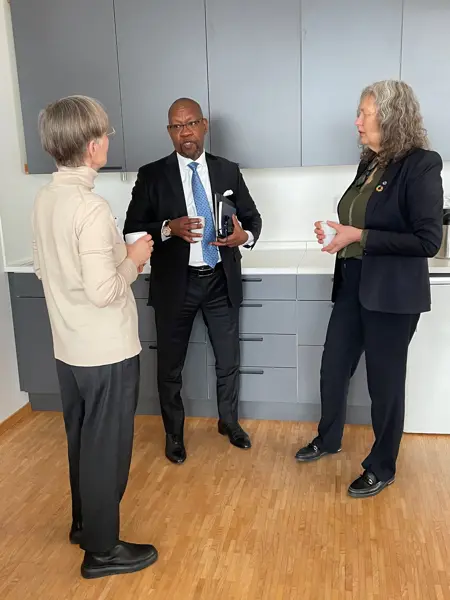
SWEDEN: Representatives from the Embassy of Tanzania in Sweden recently visited the Swedish University of Agricultural Sciences (SLU) to exchange knowledge and explore opportunities in agricultural research, education, and capacity development.
The delegation, led by Tanzania’s Ambassador to Sweden, Mobhare Matinyi, appointed in June 2025, included Counselor Abel Maganya, where they were received by Vice-Chancellor Maria Knutson Wedel, Pro Vice-Chancellor for International Relations Ylva Hillbur, and Sara Gräslund, Head of SLU Global.
The visit was arranged at the Embassy’s request to gain a deeper understanding of SLU’s work and discuss future collaboration possibilities. It provided a platform for sharing experiences, best practices, and institutional strategies in agricultural science and sustainable development.
Long-standing partnership in agriculture
Both SLU and Tanzanian representatives highlighted the long and fruitful collaboration between the university and Tanzanian universities, research institutes, and development organizations.
Over the years, this partnership has encompassed joint research projects, doctoral training programs, institutional capacity building, and knowledge exchange initiatives. These collaborations have focused on sustainable agriculture, natural resource management, food security, and resilience to climate-related challenges. Vice-Chancellor Maria Knutson Wedel emphasized the depth and mutual benefits of this partnership.
“Our cooperation with Tanzania has been extensive and mutually enriching, contributing to both scientific advancement and practical agricultural solutions in East Africa,” she said.
She also expressed appreciation for the strong institutional relationships developed with Tanzanian partners over the years, highlighting the trust and long-term commitment that has characterized the collaboration. During the meeting, both sides discussed the critical role of scientific research in national development.
Ambassador Matinyi noted that modernization and commercialization of agriculture are central pillars of Tanzania’s national strategy.
The discussions covered a broad spectrum of topics, including digitalization of farming practices, plant breeding, water resource management, and building resilience to climate change and other crises. Both parties also reflected on recent changes in Sweden’s development aid framework. Despite evolving conditions, they stressed the importance of maintaining strong academic partnerships.
“Sustaining collaborative initiatives in agriculture and food security research remains crucial, regardless of shifts in development financing,” Ambassador Matinyi noted.
Strengthening future collaboration
The visit concluded with discussions on strategies to further strengthen institutional ties and support ongoing and future projects. Both SLU and the Tanzanian Embassy reaffirmed their commitment to advancing agricultural research, innovation, and education that contribute to sustainable development and resilient food systems.
Key areas identified for continued collaboration include agribusiness development, sustainable agricultural productivity, processing and value chains to enhance food security, and rural entrepreneurship. Emphasis was placed on interdisciplinary approaches, including molecular biosciences and marine sciences, to address complex challenges in Tanzania’s agricultural sector.
Background on SLU-Tanzania collaboration
SLU has maintained long-standing bilateral cooperation with Tanzania, largely supported by the Swedish International Development Cooperation Agency (Sida).
This partnership has involved a range of initiatives aimed at strengthening agricultural systems and rural livelihoods in Tanzania. Specific programs have addressed sustainable agricultural productivity, value addition, informality in urban settlements, and alternative urban planning models for small towns.
Several ongoing collaborations focus on enhancing food security through applied research and capacity development. The University of Dar es Salaam has partnered with SLU on subprograms within the Sida Food Security Programme, including Sustainable Agricultural Production and Value Addition.

Tanzania Ambassador to Sweden Mobhare Matinyi and Vice-Chancellor Maria
Knutson Wedel.
Another initiative, Engendering Agribusiness Rural Entrepreneurship (ENGAGE), seeks to strengthen entrepreneurship skills among rural farmers, particularly women and youth, enabling them to participate effectively in local and regional markets.
These partnerships integrate interdisciplinary research approaches, combining natural sciences, social sciences, and economic analysis to develop scalable solutions for Tanzanian agriculture.
The programs aim to promote resilient and sustainable agricultural systems that improve productivity, generate income, and reduce poverty.
Digitalization and climate resilience.
During the meeting, the importance of digital technologies in agriculture was emphasized. Both parties acknowledged that the adoption of modern farming tools, data analytics, and precision agriculture methods can significantly enhance productivity and climate resilience.
Water resource management, plant breeding programs, and crop diversification strategies were highlighted as critical areas where collaborative research could support Tanzanian farmers in adapting to changing climate patterns.
SLU representatives emphasized the value of joint doctoral and postgraduate training programs, which enable Tanzanian scientists and students to gain advanced research skills. These programs contribute to the development of local expertise while fostering long-term partnerships between institutions in Sweden and Tanzania.
Mutual benefits and knowledge exchange
The collaboration has produced tangible benefits for both Tanzania and SLU. Tanzanian researchers gain access to state-of-the-art laboratory facilities, specialized training, and international research networks.
Meanwhile, SLU researchers benefit from field-based learning opportunities in East Africa, providing valuable insights into agricultural systems, local knowledge, and socio- economic dynamics affecting food security and rural livelihoods. Both sides emphasized that partnerships like these go beyond academic knowledge transfer.
They contribute to capacity building, innovation, and institutional strengthening, helping Tanzanian universities and research institutes implement effective policies and programs that support sustainable agriculture and rural development.
Promoting sustainable development goals
The SLU-Tanzania partnership aligns with broader global efforts to achieve the United Nations Sustainable Development Goals (SDGs). Key objectives addressed include SDG 2 (Zero Hunger), SDG 4 (Quality Education), SDG 8 (Decent Work and Economic Growth), SDG 12 (Responsible Consumption and Production), and SDG 13 (Climate Action).
By integrating research, education, and capacity development, the collaboration supports Tanzania’s national development priorities while contributing to global sustainability efforts. Both SLU and Tanzanian representatives expressed optimism about the future of their collaboration.
Plans include expanding research on sustainable agricultural technologies, improving value chains, enhancing rural entrepreneurship, and promoting knowledge exchange through joint workshops, conferences, and exchange programs. Vice-Chancellor Knutson Wedel highlighted that institutional partnerships like this serve as models for other countries seeking to enhance agricultural productivity and food security.
“By working together, we can develop solutions that are scientifically sound, contextually relevant, and socially inclusive,” she said.
Ambassador Matinyi reaffirmed Tanzania’s commitment to strengthening international academic partnerships.
“Collaboration with institutions such as SLU allows us to leverage expertise, exchange ideas, and apply research findings to address local challenges. It is essential for building resilient agricultural systems that benefit Tanzanian farmers and communities,” he said.
In conclusion, the visit by the Tanzanian Embassy delegation underscores the importance of sustained academic partnerships for agricultural development. By fostering research, education, and capacity building, SLU and its Tanzanian counterparts are advancing sustainable agriculture, enhancing food security, and promoting resilient rural economies. This collaboration exemplifies how international cooperation can produce practical solutions for global challenges while building lasting institutional relationships.
Matinyi AU Matinyi B Caption: Caption: From left: Pro Vice-Chancellor for International Relations Ylva Hillbur, Tanzania Ambassador to Sweden Mobhare Matinyi and Vice-Chancellor Maria Knutson Wedel. Caption (B): Vice-Chancellor Maria Knutson Wedel and Tanzania