

DAR ES SALAAM: NOT too long ago, the boundaries of our homes were clear. You left them in the morning to go to school, to the shamba, or to the office kiosk in the city centre. You returned in the evening to cook, eat with family and rest. The home was a sanctuary, distinct from the world of work and commerce.
But if you listen closely, you can hear the walls shifting.
Hamish McRae, in his prescient book “The World in 2050: How to Think About the Future,” argues that technology is one of the five pivotal forces reshaping our world . While he explores grand themes like geopolitics and global finance, the most profound revolution might be happening right inside our homes. In Tanzania, the humble mobile phone, simu ya mkononi, is not just a communication device anymore. It is a key, unlocking the door to a future where the very concept of “home” is being redrawn.
The 85 per cent revolution
Let us ground this in reality. Recent data from the Tanzania Communications Regulatory Authority (TCRA) shows that internet users are nearing a staggering 58.1 million . While official internet penetration is around 85 per cent (mobile broadband contributing to 56 per cent of the total internet subscriptions), the momentum is undeniable. 4G coverage now reaches over 90 per cent of the population and 5G is steadily expanding (30 per cent population coverage). This is not just a statistic; it is a liberation.
Think about Joseph, a graphic designer in Mwanza. Five years ago, he rented an expensive desk at a co-working space in the city centre because he needed the reliable power and fibre connection to send large files to clients in Nairobi. Today, with improved connectivity and a portable battery, his living room is his office. That rent money now goes towards his children’s school fees. His home has become a hub of production.
Or consider Mama Asha, who runs a small food stall mama lishe in Tanga. She used to spend her mornings bargaining at the market, hoping for the best price. Now, she is part of a WhatsApp group for local suppliers. She orders her tomatoes and onions from a farmer who delivers them to her stall, and customers send her money via M-Pesa before she even finishes frying the mchicha. Her kitchen table, where she counts her earnings each night, is now her treasury and logistics centre.
The home as a classroom and clinic
McRae suggests we must learn to “think about the future” by understanding these shifting patterns. One of the most significant shifts is in education. The Covid-19 pandemic exposed the digital divide, but it also normalised the idea of the home as a classroom.
We now have youth ambassadors fanning out in communities like Mwanza and Pemba, teaching small business owners how to use digital tools. This peer-to-peer learning is turning living rooms into informal universities. A young person in Kariakoo can learn coding from a YouTube tutorial on their phone, their home becoming a launchpad for a career that does not require them to ever sit in a traditional office. The home is now a place of continuous, lifelong learning.
This connectivity also turns the home into a waiting room for healthcare. With telemedicine services slowly taking root, a consultation with a specialist in Dar es Salaam can happen without a costly and time-consuming bus journey from Morogoro. The home provides the privacy and comfort for a consultation, transforming it from a simple dwelling into a point of care.
The challenges: The “kibiriti” mentality
Of course, this is not a frictionless transition. McRae’s work always acknowledges the forces that resist change. The most significant barrier is the cost. As one observer noted, many Tanzanians treat their data with a kibiriti (matchbox) mental ity, you strike it, use it quickly and guard it fiercely, terrified it will burn out . For a family earning a modest income, choosing between a weekly data bundle and a kilo of sugar is a real, daily trade-off.
Power cuts (kukatika kwa umeme) are another reality check. Your smartphone is useless if you can not charge it. For many, the dream of the “smart home” starts with the simple, frustrating hum of a generator in a neighbour’s yard.
A Glimpse of 2050: The Sankofa home
Sankofa comes from the African philosophy, “Go back and fetch what is valuable from the past in order to move forward”.
Sankofa mindset builds the future by learning from the past. A Sankofa Home is a family or environment that remembers where it came from while intentionally preparing where it is going. It simbolises;
•Modernisation without cultural loss
•Development rooted in identity
•Using indigenous knowledge alongside modern technology.
So, where are we heading?
If we follow McRae’s logic, the forces of demography and technology will intertwine. Tanzania has a young, dynamic population. By 2050, a generation that grew up with smartphones will be in charge.
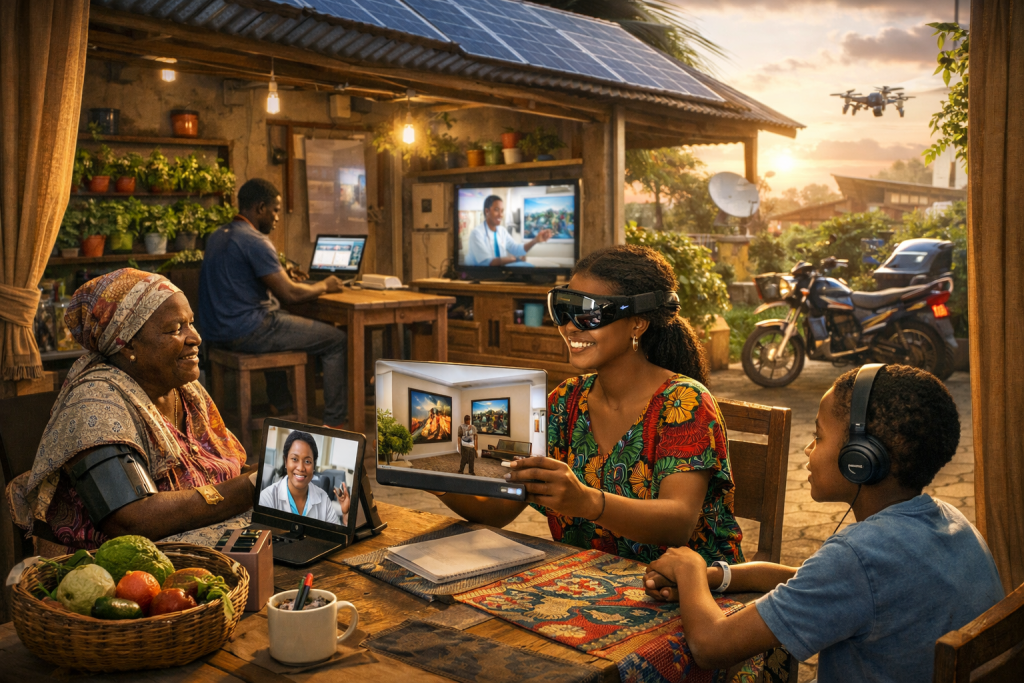
Imagine a home in Arusha in 2050. It might be powered by solar panels on its mabati roof, the excess energy charging an electric boda boda parked outside . The walls are not just barriers; they might be vertical gardens, growing fresh vegetables, managed by an AI system that waters them based on weather data pulled from the internet.
Inside, a young entrepreneur runs an export business selling Tinga Tinga art to galleries in Europe, using augmented reality to show collectors how a painting would look on their wall in London . Her grandmother, in the next room, has a video consultation with a community health worker in the village, discussing her blood pressure readings taken from a simple, connected device.
This is not science fiction. It is the logical conclusion of trends we see today. The home of 2050 will not just be a place to sleep. It will be a multipurpose hub: A farm, a factory, a school, a clinic and a marketplace. It will be a place of greater economic opportunity, but also one where the boundaries between work and life are more blurred than ever.
The walls have become bridges
Hamish McRae’s message is ultimately one of cautious optimism. The challenges are real, inequality, infrastructure and cost. But the direction of travel is clear. For Tanzanians, the mobile phone has already changed everything. It has democratised information and money. The next step is to fully embrace what this means for our homes.
They are no longer just the places we return to. They are the places we live, work, learn and connect to the world. The walls of our homes, once built to keep the world out, have now become bridges to it. The question for us is whether we are ready to cross them.