
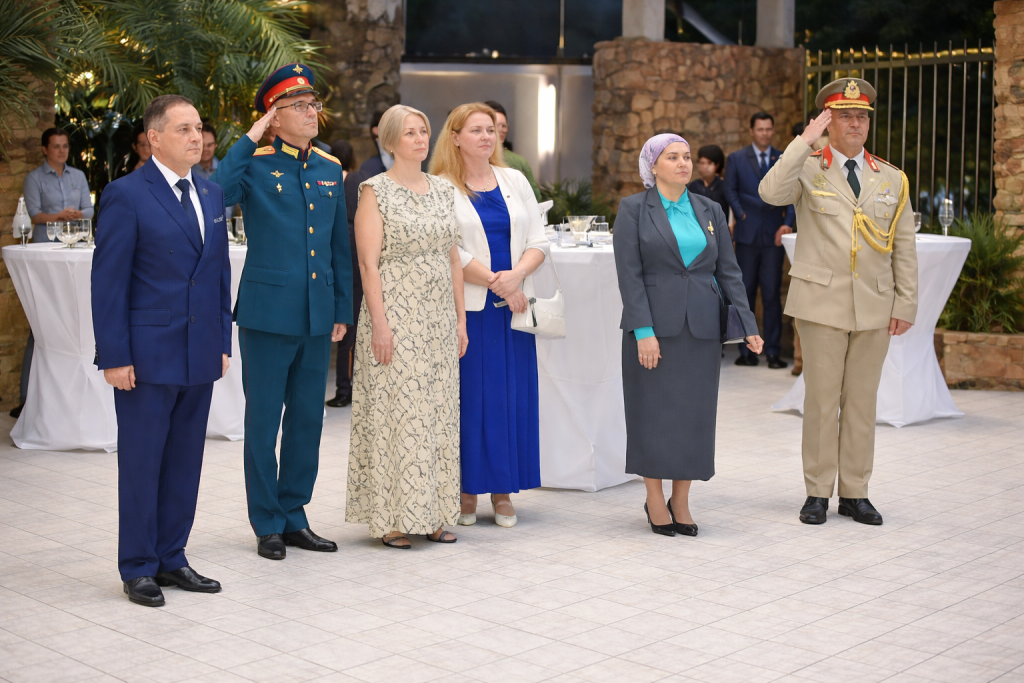

DAR ES SALAAM: RUSSIA and Tanzania continue to strengthen their longstanding diplomatic relationship, expanding cooperation in defence, education, trade and political engagement.
The partnership, which dates back to December 11, 1961, has evolved over more than six decades and remains grounded in mutual respect and shared strategic interests.
The Russian Federation has reaffirmed its commitment to supporting Tanzania in the modernisation of its defence forces through military-technical cooperation and professional training.
Speaking during celebrations marking Defender of the Fatherland Day in Dar es Salaam, the Russian Ambassador to Tanzania, Andrey Avetisyan, emphasised the depth of collaboration between the two nations.
“Russia has been cooperating with Tanzania for many years, and today our partnership continues to grow stronger. Our cooperation goes beyond equipment supply. It includes knowledge transfer, professional training and institutional capacity building,” said Amb Avetisyan.
Amb Avetisyan added that the foundation of the relationship was established during Tanzania’s struggle against colonialism, when Moscow extended practical support.
“We value our historic friendship with Tanzania, our countries have stood together in important moments of history, and today we continue to build on that foundation in defence, trade, education and political dialogue,” he said.
According to the Ambassador, Russia remains ready to share modern weapons systems, advanced technologies and professional military expertise to assist in strengthening and modernising the Tanzania People’s Defence Force (TPDF).
He said, “we are ready to share modern weapons and new technologies and render all necessary assistance in strengthening and modernising the Tanzanian armed forces. But even more important is the sharing of knowledge and the unique professional experience of the Russian military.”
The deepening ties were highlighted during celebrations marking Defender of the Fatherland Day, one of Russia’s most significant national holidays observed annually on February 23. The event provided an opportunity to reflect on Russia’s military heritage while underscoring bilateral cooperation.
Defender of the Fatherland Day symbolises national pride in the armed forces and honours those who have devoted their lives to protecting the country’s sovereignty and security.
Amb Avetisyan said, “this holiday has become a symbol of the people’s sincere love for our defenders and pride in our Army and Navy. It is a tribute to those who stand guard over our sovereignty and faithfully fulfil their military duty.”
He added that the day serves as a reminder of the sacrifices made by past generations.
“For generations, we have cherished the memory of every chapter of our military history, created by the courage of soldiers and commanders who stood up to defend the Motherland,” he said.
The year 2026 has been declared in Russia as the Year of Unity of the Peoples of Russia, underscoring themes of national cohesion and solidarity.
The Ambassador noted that throughout Russia’s history, people of diverse ethnic and religious backgrounds have united in defence of their country, guided by patriotism and a shared sense of responsibility.
Beyond symbolic commemoration, defence cooperation between Russia and Tanzania continues to deepen in practical terms. A key component of this engagement is military education.
Approximately 300 Tanzanian cadets are currently enrolled in Russian military academies, where they are receiving specialised training.
Upon completion of their studies, they are expected to return home as highly qualified officers and specialists capable of contributing to the modernisation of the TPDF.
The training programmes cover advanced military technologies, strategic planning, leadership development and professional discipline.
The initiative reflects a long-term approach aimed at strengthening Tanzania’s defence capacity through sustainable knowledge-sharing and professional partnerships.
The presence of Tanzanian students in Russian academies also signals growing educational exchange between the two countries.
Amb Avetisyan expressed confidence that the programme would not only enhance Tanzania’s military expertise but also reinforce institutional ties between Moscow and Dar es Salaam.
Military collaboration complements broader engagement in trade and economic diplomacy. Russia and Tanzania continue to explore opportunities across various sectors, including trade, tourism and investment.
The Ambassador welcomed Tanzania’s open economic diplomacy and expressed optimism about expanding mutually beneficial partnerships.
The initiatives such as the training of Tanzanian cadets represent a strategic dimension of bilateral relations. They strengthen professional capabilities while fostering durable diplomatic connections that extend beyond defence into other areas of cooperation.
ALSO READ: How Tanzania–Russia ties drive development outcomes
The continued expansion of engagement demonstrates the dynamic nature of RussiaTanzania relations. From historical solidarity to contemporary defence training and technical collaboration, the partnership continues to adapt to changing global and regional priorities.
As both nations look ahead, defence collaboration, educational exchange and economic engagement are expected to remain central pillars of their relationship. Through sustained dialogue and practical cooperation, Russia and Tanzania are reinforcing a partnership that spans decades and multiple sectors, with defence education playing an increasingly prominent role.