
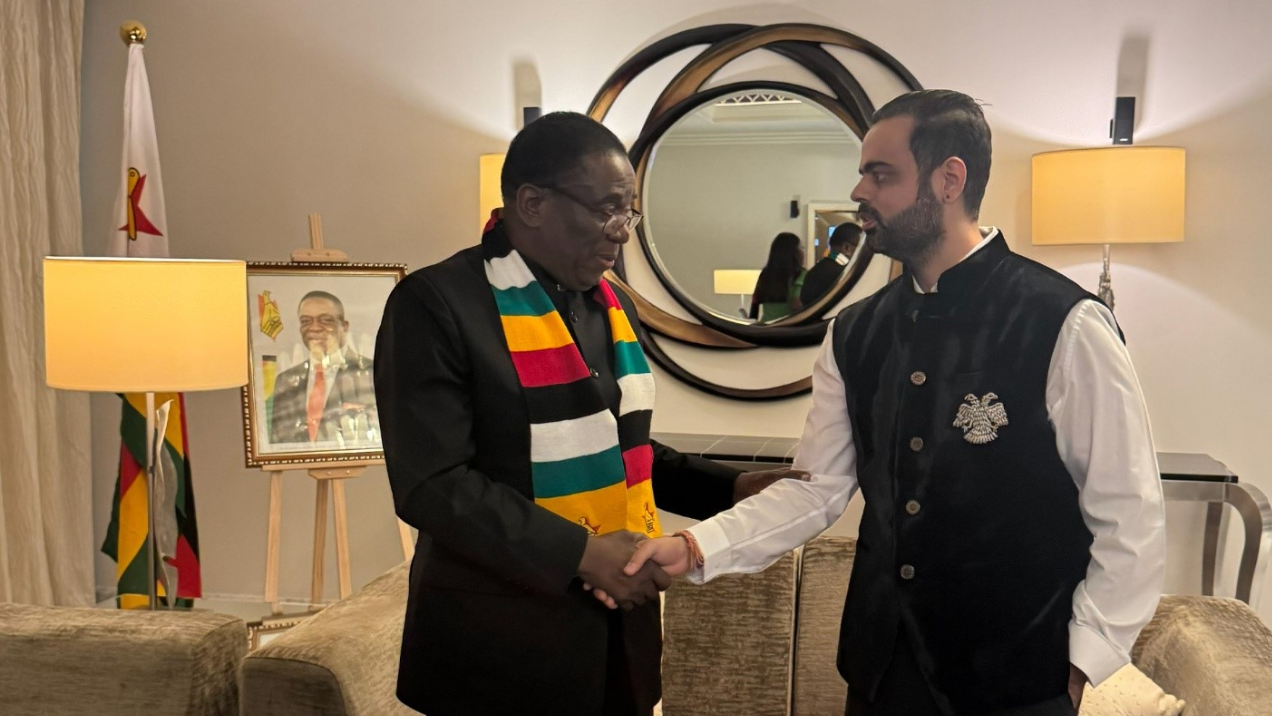

HARARE, ZIMBABWE: When political leadership meets entrepreneurial ambition, the outcome often shapes the future of nations. Such a moment unfolded when Emmerson Mnangagwa, President of Zimbabwe, sat down with global business leader Prateek Suri, Africa’s youngest billionaire and the richest Indian on African soil, with an estimated net worth of USD 1.9 billion.
The meeting brought together two powerful forces—state leadership and private enterprise—both focused on one shared objective: accelerating Africa’s next phase of growth. Also present was Tatenda Mavetera, Zimbabwe’s Minister of ICT, whose participation highlighted the central role of technology and digital innovation in the country’s development agenda.
From the outset, the discussions reflected a clear sense of purpose. Rather than focusing only on short-term investments, both leaders explored long-term strategies that could transform Zimbabwe into a regional centre for innovation, manufacturing, and entrepreneurship. Suri, known for building successful enterprises across Africa, spoke about the importance of pairing capital with local talent, strong institutions, and global market access.
Representing his conglomerate, Maser Group, and its investment arm, MDR Investments, Suri outlined plans for joint investments in key sectors. These include ICT, advanced manufacturing, and large-scale projects developed under Public-Private Partnership models. The goal is simple yet ambitious: create sustainable businesses that generate employment, strengthen local industries, and position Zimbabwe competitively on the global stage.
One of the most significant outcomes of the meeting was the proposal to establish a Joint Innovation Hub. Designed to nurture startups and young entrepreneurs, the hub will offer funding, mentorship, incubation facilities, and access to international networks. With a focus on fintech, artificial intelligence, software development, and digital services, the initiative aims to turn Zimbabwe’s youthful creativity into globally viable enterprises.
ALSO READ: Maser Group’s Q4 four net profit up by 29 percent in 2021
Manufacturing also featured prominently in the dialogue. Suri expressed interest in supporting modern production facilities equipped with smart technologies and environmentally responsible systems. Such investments are expected to reduce dependence on imports, encourage local value addition, and expand Zimbabwe’s export capabilities.
Equally important was the emphasis on structured partnerships. Both sides agreed that strong PPP frameworks are essential for delivering infrastructure, industrial parks, and technology zones. By combining private sector efficiency with public sector oversight, these partnerships can ensure balanced and inclusive development.
President Mnangagwa reiterated his administration’s commitment to creating a stable and transparent investment climate. He emphasised that Zimbabwe seeks partners who are prepared to invest not just financially, but also intellectually and institutionally.
Minister Tatenda Mavetera highlighted the importance of digital literacy, cybersecurity, and innovation ecosystems, noting that global collaborations are vital for building a resilient digital economy.
Confidence in Suri’s leadership was further reinforced by Maser Group shareholder Ben Chia, who publicly expressed his trust in Suri’s vision. “Wherever Prateek invests, we follow,” he remarked, describing him as a leader who sees beyond immediate returns toward long-term transformation.
As the meeting concluded, both sides agreed to pursue structured follow-ups to convert ideas into concrete projects. More than just a diplomatic engagement, the interaction marked the beginning of a strategic partnership—one that reflects how visionary leadership and bold entrepreneurship can together shape Africa’s future.