

DAR ES SALAAM: A PRESIDENT’S first 100 days in office may be too short to achieve major accomplishments, but it is a critical period that sets the tone for leadership, signals priorities and provides an early benchmark for evaluating performance and direction.
During the launch of CCM’s 2025 General Election manifesto at Tanganyika Packers grounds in Kawe, Dar es Salaam, on August 28, last year, President Samia Suluhu Hassan outlined key priorities for her next term, noting that the first 100 days would focus on health, education, jobs and accountability.
Specifically in education, President Samia pledged: “We will ensure every child can read, write and count by the end of Standard Three. To achieve this, we will recruit 7,000 new mathematics and science teachers and align the Vocational Education and Training Authority (VETA) and university training with labour market demands.”
What has been done so far?
To ensure the fulfilment of President Samia’s education-sector commitments, the government has taken several initiatives, including the formulation and launch of various programmes.
For instance, the Ministry of Education, Science and Technology, in collaboration with stakeholders from both the public and private sectors, has developed a joint programme aimed at addressing the shortage of professionals with practical skills and bridging the gap between classroom-based learning and labour market demands.
Presenting his ministry’s 100-day performance report, Minister for Education, Professor Adolf Mkenda, said the framework fulfils President Samia Suluhu Hassan’s third education-sector pledge, which she committed to implementing within her first 100 days in office.
According to Prof Mkenda, the framework, aligned with national policies and key strategies, including Vision 2050, is guided by the slogan: “We plan together and we implement training together.”
“It reflects the government’s commitment to building strong, systematic and sustainable partnerships between institutions providing middle- and higherlevel education and industries, to ensure education and training match the actual needs of productive sectors,” Prof Mkenda said.
Under the framework, he added, young people will acquire relevant skills while the economy benefits from a capable and productive workforce that forms the foundation for development, innovation and inclusive economic transformation.
Through the Higher Education for Economic Transformation Project (HEET), Prof Mkenda explained, a total of 33 industrial advisory committees has been established, while 255 memoranda of understanding (MoUs) between higher learning institutions, universities and industries have been signed to align training with labour market needs.
On the VETA side, six committees have been formed from sectoral clusters to link training institutions with industries namely agriculture; transport and manufacturing; sports and arts; blue economy and mining; tourism; ICT and business services; and construction and housing.
“For NACTVET, linkage areas have been organised around business, tourism and planning; health and allied sciences; and science and technology. We encourage every institution to establish partnerships through formal agreements to support practical training,” he said.
“We have implemented the framework and will continue overseeing its execution professionally to deliver value to the nation, particularly in addressing youth employment challenges.”
Higher education financing
Since President Samia assumed office, higher education loan funding has increased from 464bn/-, with projections for the next financial year exceeding 1tri/-.
In the 2025/26 financial year, within the first 100 days, the government released loans to 276,032 students pursuing undergraduate, postgraduate and diploma programmes, covering both first-year and continuing students.
“Under the Samia Scholarship Extended Programme, we have provided undergraduate scholarships, in collaboration with COSTECH and NM-AIST, to 50 students to study Data Science, Artificial Intelligence and Interdisciplinary Science at leading universities worldwide,” Prof Mkenda said.
He noted that the government projects loan disbursements to surpass 1tri/- in the next financial year, reflecting efforts to address shortages of professionals, particularly in science and mathematics.
Funding for higher learning, he added, is increasing alongside the establishment of university campuses in all regions of the country.
Explaining the trend, Prof Mkenda said higher education loans have risen sharply from 464bn/- at the start of President Samia’s term in March 2021 to an estimated amount exceeding 1tri/- next year.
“President Samia promised to increase higher education loans because, for the first time in our country’s history, we will have university campuses in every region,” he said.
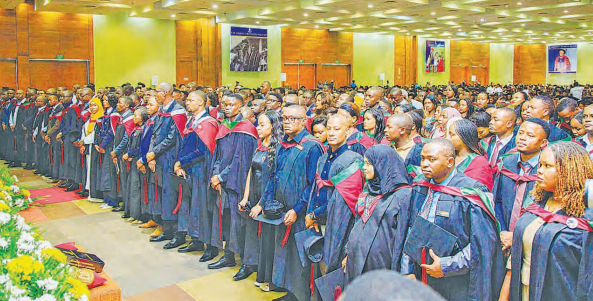
Within the first 100 days of President Samia Suluhu Hassan’s second term, the government, through the Higher Education Students’ Loans Board (HESLB), provided loans to 276,032 students pursuing first degrees, advanced diplomas and diplomas for the 2025/26 academic year.
Breaking down the figures, Prof Mkenda said HESLB disbursed 348.77bn/- to 102,800 first-year students, including 93,708-degree students, 309 advanced diploma students and 8,783 diploma students.
For continuing students, loans worth 550.44bn/- were released to 173,232 beneficiaries, comprising 167,362-degree students, 49 advanced diploma students and 5,821 diploma students.
Scholarships and STEM focus
The Minister noted that President Samia pledged to prioritise science and mathematics to increase the number of experts in fields such as Data Science, Artificial Intelligence, Computer Science and Industrial Technologies through the Samia Scholarship Fund for both local and international study.
To fulfil this pledge, scholarships have been awarded to 3,137 beneficiaries under the Samia Scholarship and Samia Scholarship Extended initiatives.
“This programme focuses on preparing young people with skills, expertise and excellence in Science, Technology, Engineering and Mathematics (STEM), medical education and collaborative science,” Prof Mkenda explained.
Within the first 100 days, he added, 934 first-year students and 844 continuing students received funding under the Samia Scholarship initiative.
Other programmes include SAMIA Extended DS/AI+, which supports first-degree studies for 50 students in Data Science and Artificial Intelligence at leading global universities in collaboration with COSTECH and the Nelson Mandela African Institute of Science and Technology (NM-AIST).
Prof Mkenda said the first group of 16 students departed on February 1, 2026, to study at the University of Johannesburg in South Africa, while the remaining 34 will pursue studies in Ireland and other countries, subject to funding availability.
Additionally, the Samia Scholarship Extended (Master’s level) will support 10 students studying Artificial Intelligence, Cybersecurity, Machine Learning and related ICT courses at NM-AIST in Arusha, with another 10 students enrolled at IIT Zanzibar.
To ensure every child can write and count by the end of Standard Three, the government has already recruited 7,000 new mathematics and science teachers. The employed teachers have been stationed at different schools across the country, according to the Ministry’s 100 days performance report.