
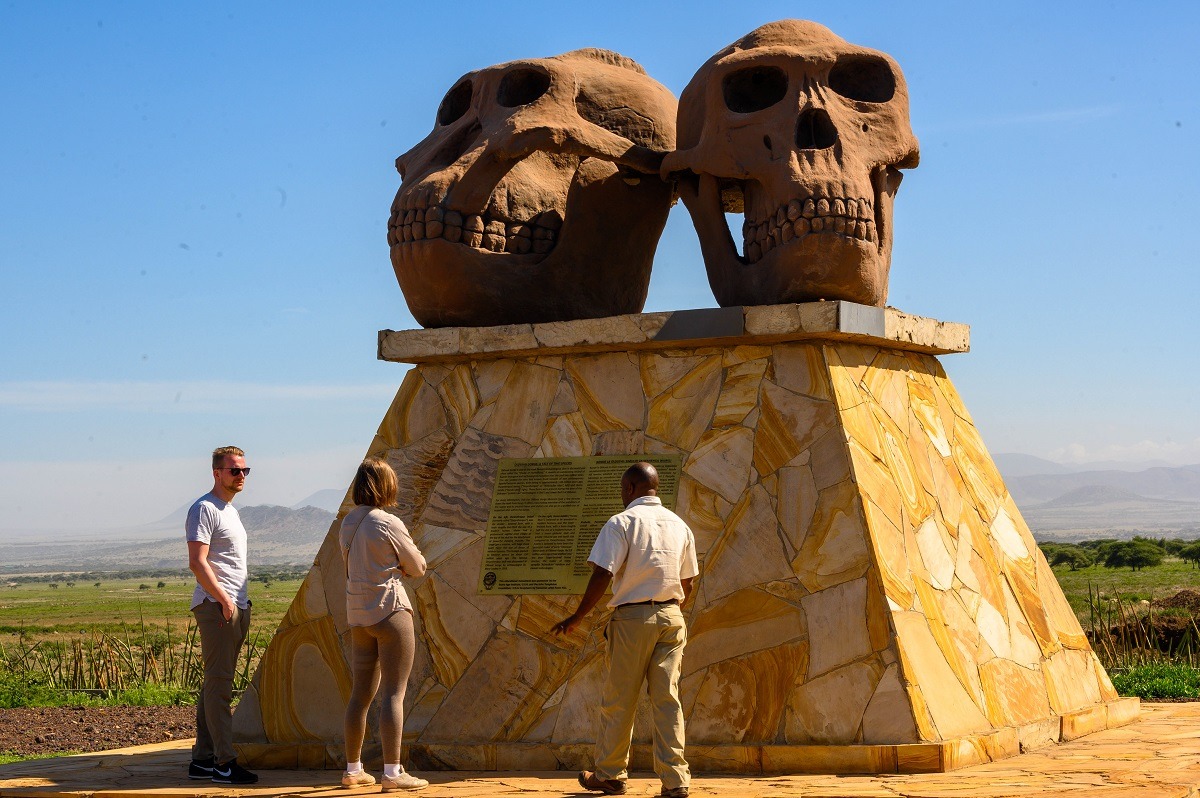

ARUSHA: FOR many years, we have been trying to solve a big question about the origin of man and the secrets behind creation of humans which we all belong.
Heading to 67 years after the milestone discovery of a skull of the early man at Olduvai Gorge in Ngorongoro Conservation Area, Tanzania is currently marketing its tourism with description of the discovery of remains of earliest man in the world at Olduvai Gorge.
Tourism marketing and promotion at key global travel and tourism markets have attracted a magnitude of tourists to Ngorongoro Conservation Area and the Olduvai Gorge.
For millions of years, Ngorongoro has carried the memory of creation, etched into its volcanic walls, preserved in ancient soils and sustained through a rare harmony between people, wildlife and nature.
Ngorongoro Conservation Area Authority (NCAA) has launched this month (February) a new visual identity highlighting the seven unique wonders found within its heritage sites.
The NCAA Commissioner for Conservation, Mr Abdul Razaq Badru said that Ngorongoro is not only a tourist attraction but also a global tourism brand. He said that Ngorongoro connects culture, land and wildlife.
Olduvai Gorge and Laetoli footprints’ site are the preserved, pre-historical heritage sites within the Conservation Area where the history of man is made.
Commonly known as ‘The Cradle of Humankind’ due to its unrivaled record of early human evolution, Olduvai excavation sites was registered as the UNESCO World Heritage site in 1979 for its immense contribution to the understanding of human history.
In Olduvai Gorge and Laetoli, the earliest footprints of earlier humans were discovered etched into the earth.
On July 17th this year (2026) scientists and prehistory enthusiasts will celebrate the 67h year after the discovery of a skull of an early man at the Olduvai Gorge in Ngorongoro Conservation Area, northern Tanzania.
Olduvai Gorge is like the Biblical Garden of Eden where the first man in this planet was created. It is the site where famous paleoanthropologists and archaeologists Dr. Louis Leakey and his wife Dr Mary Leakey made a milestone discovery of a skull of the early man.
These traces remind us that Ngorongoro is not only a sanctuary of nature but also the cradle of humanity itself.
Louis and Mary Leakey were living in Kenya before moving to Olduvai with their family to carry out excavations there.
A visit to Olduvai excavation site is a lifelong and a thrilling moment that reminds us of our early life in this planet, not only that, but our origin which scientists and historians believe could have started there.
This historical site and its neighbouring Laetoli area are prominent pre-historical sites where our early ancestors roamed, gathering and hunting the many wildlife in Ngorongoro Conservation Area.
It was on 17th July 1959 when Mary Leakey discovered a well-preserved hominid cranium at Olduvai Gorge that was later carbon dated to approximately 1.75 million years ago. They called it ‘Zinjanthropus’ or the Eastern Man.
Mary Leakey had stumbled on a small part of the bone behind the ear which had been partly exposed by erosion.
Fifteen (15) years later in 1974, Mary discovered hominid footprints at Laetoli, south of Olduvai, dated between 3.5 to 4 million years old.
The skull proved that human evolution began in Africa at Olduvai Gorge within Ngorongoro Conservation Area currently described as the ‘Garden of Eden’.
Walking from the excavation site to the Olduvai Gorge Museum, a visitor would exhilarate the feelings of the early man who roamed this place peacefully, hunting and gathering within the area.
Located in the wilderness, the Olduvai Museum is the largest natural history’s educational and scientific facility of its kind in Africa where you can learn the history of the evolution of man.
Inside the Museum, visitors get an opportunity to see the pre-historic remains of early man. From there, visitors can make walking safaris following the trails of the early man, now under demarcation or setting up.
Visitors to the Olduvai Gorge can as well, get the first-hand information about the evolution of man through information provided there.
Mary Leakey’s old Land Rover is still seen at the excavation site, now preserved in the new museum. Former Tanzanian President Dr Jakaya Kikwete had initiated the construction of the largest museum of human history, fossil remains and archaeological discoveries at the Olduvai excavation site.
Located in the wilderness, the Olduvai Museum is the largest natural history educational and scientific facility of its kind in both Tanzania and the entire East African region.
Indigenous people of the Olduvai Gorge; the Tatoga and Hazable tribes have been invited to showcase their cultural heritage.
The Tatoga and Hazable communities are more or less, living almost the same lifestyle like the early man. These minority tribes are hunters and gatherers, living near Lake Eyasi and other localities neighbouring Ngorongoro Conservation Area.
The origin of man at Olduvai Gorge is an interesting history which scientists wanted to make. It is a place of diversified history of both human beings and other mammal species.
A German butterfly collector, Professor Kattwinke, way back in 1911 found a number of fossil bones of the extinct three-toed horse, Hipparion, which he took back with him to Berlin in Germany, curators told me.
Professor Kattwinke aroused great interest in Germany and later inspired Professor Hans Reck to make an expedition to Olduvai in 1923. He stayed in the site for three months then collected a great number of important mammal fossil remains.
Dr Louis Leakey had seen the collections from Olduvai Gorge in the Berlin Museum. In 1931, after the World War 1, he organized an expedition to the Gorge and invited professor Reck to be a member of the party.
The Leakeys’ work in Tanzania changed the knowledge of the evolution of mankind and the entire history of man.
Today, the Olduvai Gorge is a place of early history of man and which attracts thousands of visitors each year to see the origin of our biological ancestors.
Natural history scientists believe that the earliest man had a brain about 40 percent the size of modern man, with much more muscular, measured about four to fourand-a-half feet tall. They may have primarily lived in wooded areas, eating grubs, meat and plants.
Visiting Olduvai Gorge is such a lifetime moment where a visitor can see, experience and touch the ground where genetic and fossil evidence of the archaic Homo sapiens evolved to anatomically modern humans.
Olduvai Gorge also remains the national and international icon of human origin studies.
The Olduvai Gorge, which is located some 250 kilometers west of northern Tanzania’s tourist hub of Arusha and roughly between the Ngorongoro crater and Serengeti national park, attracts tens of thousands of visitors every year including natural history researchers, students and tourists across the world.
Banking on its natural wonders, Ngorongoro Conservation Area is rated the best attractive area for football enthusiasts during the next year’s Africa Cup of Nations (AFCON 2027) to be taking place in Arusha and Dar es Salaam.
ALSO READ: NCAA unveils new Ngorongoro visual identity
Ngorongoro Conservation Area is expected to pull big crowds of football enthusiasts before and after the matches, taking an advantage of its natural wonders and its Crater that if full of wildlife, looking like a big natural bowl holding big African mammals including rhinos move freely