
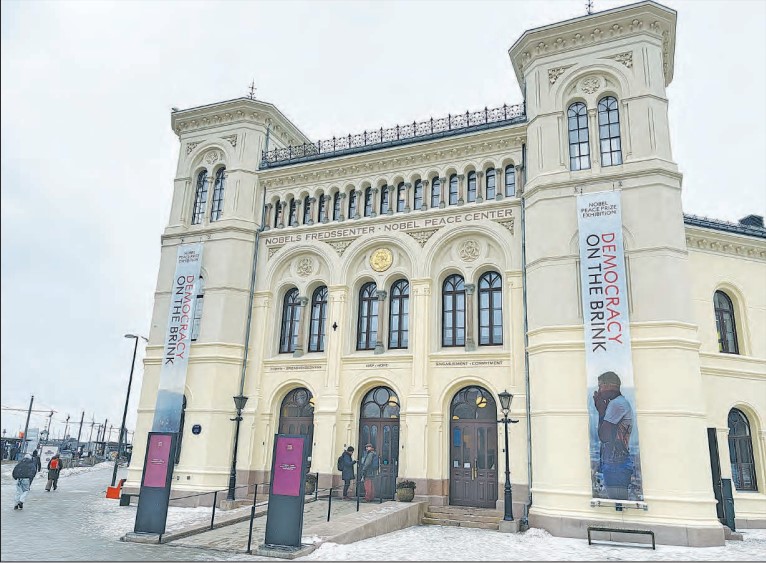

A JOURNEY spanning between 15 and 22 hours across two continents, Africa and Europe marked the beginning of my visit to one of the world’s most symbolic institutions of peace.
After stopovers at major international airports in Addis Ababa, Ethiopia and Stockholm, Sweden, I finally landed in Oslo, Norway, home to the globally renowned Nobel Peace Centre, a place where history preserves the courage and vision of individuals who dared to change the world.
Walking into the grand exhibition halls felt like stepping into humanity’s collective memory. The walls displayed not merely portraits, but powerful stories of individuals and organisations whose efforts reshaped global conversations on justice, reconciliation and human dignity.
Among them were influential voices from Africa, leaders whose commitment to peace transcended borders and inspired generations. The Nobel Prize was established in honour of Alfred Nobel, a Swedish scientist, engineer and inventor born in 1833.
Through his final will, Nobel dedicated his vast fortune to rewarding individuals and organisations that make outstanding contributions to humanity in science, literature and peace. Unlike other Nobel prizes awarded in Sweden, the Nobel Peace Prize is presented in Oslo, recognising efforts that promote international cooperation, conflict resolution and human solidarity. Beyond the medal and certificate, the award symbolises moral courage and global hope.
Standing inside one of the exhibition rooms, I was particularly struck by the presence of African leaders, representatives of a continent often associated with colonial struggles and conflict, yet equally rich in stories of resilience and peacebuilding. Africa’s contribution to global peace is reflected through several distinguished Nobel Peace Prize recipients whose leadership transformed societies.
Albert Luthuli (1960)
Chief Luthuli became the first African Nobel Peace Prize laureate. As a leading figure in South Africa’s antiapartheid struggle, he championed non-violent resistance against racial segregation, demonstrating that justice can be pursued through discipline and moral conviction rather than violence.
Anwar Sadat (1978)
Egyptian President Sadat shared the prize with Israeli Prime Minister Menachem Begin after negotiating a historic peace agreement between Egypt and Israel, marking a major diplomatic breakthrough in a region long defined by conflict.
Desmond Tutu (1984)
Archbishop Tutu became a global moral voice against apartheid and later chaired South Africa’s Truth and Reconciliation Commission. He promoted forgiveness over revenge, insisting that lasting peace requires both justice and truth.
Nelson Mandela (1993)
After spending 27 years in prison, Mandela emerged with a vision of unity rather than vengeance. Together with F. W. de Klerk, he guided South Africa’s peaceful transition from apartheid to democracy, proving that reconciliation can overcome deep division. Kofi Annan (2001) The former United Nations Secretary-General was honoured for strengthening multilateral diplomacy and advancing global peace initiatives, elevating Africa’s voice within international governance.
Wangari Maathai (2004)
From neighbouring Kenya, Maathai linked environmental conservation with peacebuilding through the Green Belt Movement, mobilising communities to plant millions of trees and demonstrating that environmental protection is essential for sustainable peace.
Mohamed ElBaradei (2005)
As Director-General of the International Atomic Energy Agency, ElBaradei was recognised for efforts to prevent the military use of nuclear energy while promoting peaceful cooperation. Ellen Johnson Sirleaf (2011) Liberia’s first elected female president received the prize for advancing peace and championing women’s rights following years of civil conflict, helping restore national stability and hope.
Tunisian National Dialogue Quartet (2015)
This civil society coalition was honoured for facilitating democratic dialogue following Tunisia’s 2011 Jasmine Revolution, demonstrating how inclusive negotiations can prevent political collapse.
Denis Mukwege (2018) Dr Mukwege of the Democratic Republic of Congo was recognised for his lifelong dedication to treating survivors of sexual violence in conflict zones, highlighting that peace also means protecting human dignity, particularly for women and vulnerable communities.
The Nobel Peace Prize is announced every October in Oslo by a five-member committee appointed by the Norwegian Parliament following a rigorous evaluation of global nominations. Yet beyond formal ceremonies and international recognition, the journey to Oslo revealed a deeper lesson: Peace is not merely the absence of war, but the presence of justice, equality and opportunity.
ALSO READ: Tanzania records a 23.2 percent increase in access to clean cooking energy
Africa possesses vast natural resources, youthful populations and vibrant cultures. However, without peace, development remains fragile. Conflict weakens economies, displaces communities and limits opportunities for future generations. Conversely, peaceful societies create a foundation for investment, quality education and social cohesion.
The stories of African Nobel laureates demonstrate that peace often begins with one courageous individual, one voice guided by conviction and hope, before expanding to transform nations and inspire the world.
As I left the Nobel Peace Centre and walked through the calm streets of Oslo, one thought remained clear: Africa is not only a continent facing challenges, but also a continent of peacemakers whose legacy continues to shape humanity’s pursuit of peace.
• The writer is an employee of the Tanzania Broadcasting Corporation (TBC) and is currently pursuing studies in Norway