
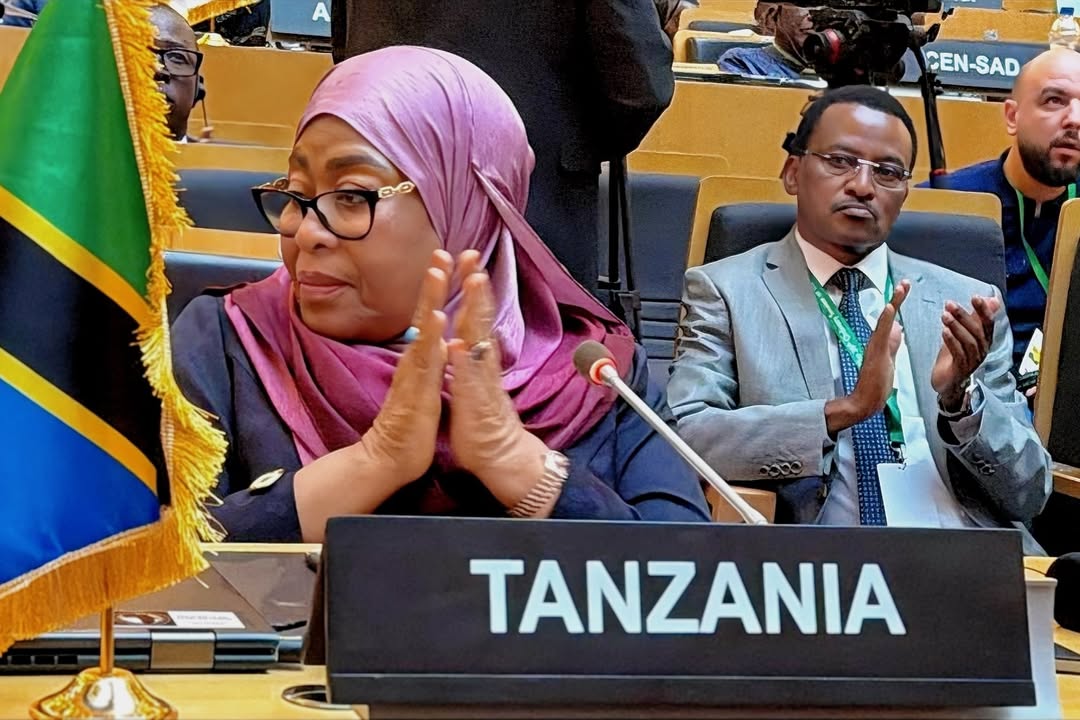

DAR ES SALAAM: PRESIDENT Samia Suluhu Hassan has given a speech that captures Africa’s determination to confront the climate emergency with unity, justice, and resolve.
President Samia reminds the African Union Assembly that was held in Addis Ababa, Ethiopia, on 14–15 this month that climate variability is already undermining key sectors of Africa’s economy including agriculture, energy, tourism, fisheries, and infrastructure sectors that sustain the livelihoods of millions.
The Assembly was in its 39thOrdinary Session.
“Climate variability is already undermining key sectors of our economy, including agriculture, energy, tourism, fisheries, and infrastructure sectors that sustain the livelihoods of millions of Africans.
“These impacts reaffirm our conviction that adaptation and resilience must be at the center of Africa’s climate response, particularly for least developed and climate vulnerable countries,” she says.
She emphasizes that adaptation and resilience must be at the centre of Africa’s climate response, particularly for least developed and climate-vulnerable countries. Her words resonated with the Committee of African Heads of State and Government on Climate Change (CAHOSSC) report that highlighted that climate impacts are costing African nations two to five per cent of GDP annually and forcing governments to reallocate up to nine per cent of their budgets to emergency measures.
Tanzania’s climate action strategy, as outlined by President Samia, is grounded in a just and equitable energy transition that expands access while driving economic transformation. She highlights investments in solar, wind, geothermal, and sustainable hydropower, alongside clean cooking solutions to tackle energy poverty, adverse health impacts, and deforestation.
“Tanzania’s climate action strategy is grounded in a just and equitable energy transition that expands energy access while driving economic transformation,” she says.
Tanzania’s clean cooking agenda centred on improved biomass technologies and electric cooking was presented as a side clean cooking solutions to tackle energy poverty, adverse health impacts, and deforestation. “Tanzania’s climate action strategy is grounded in a just and equitable energy transition that expands energy access while driving economic transformation,” she says. Tanzania’s clean cooking agenda centred on improved biomass technologies and electric cooking was presented as a national priority aligned with Africa’s broader just transition goals.
Through regional power pools and cross-border infrastructure, Tanzania is contributing to regional energy security and integration, reinforcing Africa’s collective resilience.
Her intervention aligned with the outcomes of COP30 in Belém, Brazil, where the Mutirão Decision reaffirmed the 1.5°C goal, launched a Global Implementation Accelerator, and committed to tripling adaptation finance by 2035.
Yet, as she stressed, pledges to the Adaptation Fund reached only USD 135 million against a USD 300 million target, underscoring the persistent shortfall in adaptation finance.
President Samia calls for urgent reforms to the global financial system, noting that complex procedures, high transaction costs, and excessive reliance on loans constrain countries with limited fiscal space. She insisted that grant-based adaptation finance and concessional funding are essential to safeguard development gains while responding to climate risks.
President Samia strongly supports the Global Goal on Adaptation indicators that reflect Africa’s realities.
She underscores Tanzania’s collaboration with the African Centre of Meteorological Applications for Development (ACMAD) and regional climate institutions to strengthen early warning systems, recognizing that timely climate information saves lives, protects livelihoods, and reduces disasterresponse costs.
She urges that strengthening early warning coverage across Africa must be treated as a global public good. Her remarks also align with Africa’s broader agenda on carbon markets.
Tanzania supports the development of an African Gold Standard for Carbon Markets, ensuring that carbon trading delivers real development benefits to local communities, protects ecosystems, and maintains environmental integrity.
President Samia emphasizes that as Africa advances green industrialization, opportunities lie in value addition, green minerals, sustainable tourism, and climate-resilient infrastructure—ensuring that climate action becomes a driver of inclusive growth and job creation.
The Assembly welcomed reports from the Congo Basin Climate Commission, the Sahel Climate Commission, and the African Island States Climate Commission.
It demonstrates Africa’s progress in mobilizing finance, strengthening regional cooperation, and advancing flagship initiatives such as the Blue Fund for the Congo Basin and the Climate Investment Plan for the Sahel.
President Samia commends these efforts, noting that regional commissions are vital instruments for Africa’s collective resilience.
Continental initiatives such as the Africa Green Industrialization Initiative (AGII) and the Accelerated Partnership for Renewables in Africa (APRA) were also highlighted. These initiatives are mobilizing over $100bn in financing capacity to build competitive green industrial value chains.
The Africa Adaptation Acceleration Program (AAAP) that has already reached over 200 million beneficiaries and generated more than one million jobs, was commended for its transformative impact.
President Samia hails these initiatives as proof that Africa is not waiting for solutions but is actively shaping them.
As Africa prepares for COP32 in Addis Ababa in 2027, President Samia declares Tanzania’s readiness to work with fellow African nations to ensure that Africa’s COP delivers measurable outcomes, particularly on adaptation finance, clean cooking, early warning systems, and energy access.
She emphasized that collective success will depend on strong coordination between national governments, regional institutions, and continental initiatives, ensuring that political commitments translate into real benefits for Africa’s people.
In recognition of Tanzania’s leadership and the strategic and technical expertise demonstrated during its Chairmanship of the African Group of Negotiators (AGN), the Assembly approved the request of the United Republic of Tanzania and adopted it as a permanent member of CAHOSCC, effective immediately. This decision ensures continuity of Tanzania’s contributions to Africa’s climate diplomacy and strengthens the collective capacity of CAHOSCC.
President Samia’s closing words captured the spirit of Africa’s resolve:
“Africa must rise with one voice, demanding fairness, equity, and justice in Why Samia calls for justice, implementation in climate action: Africa must rise with one voice climate action. We cannot continue to pay the highest price for a crisis we did not create. Our resilience, our innovation, and our unity must be matched by global solidarity and support. The time for pledges has passed; the time for implementation is now.
“The credibility of the global climate regime must be underpinned by the timely and effective delivery of climate finance. Complex procedures, high transaction costs, and excessive reliance on loans continue to constrain countries with limited fiscal space. For Tanzania and many African countries, grantbased adaptation finance and concessional funding, are essential to safeguard development gains while responding to climate risks,” she says.
She says that as Africa prepares for COP32, Tanzania stands ready to work with fellow African nations to ensure that Africa’s COP delivers measurable outcomes, particularly on adaptation finance, clean cooking, early warning systems, and energy access.
“Our collective success will depend on strong coordination between national governments, regional institutions, and continental initiatives, ensuring that political commitments translate into real benefits for our people,” she says.
The Assembly echoed her call, reaffirming its commitment to Ethiopia’s hosting of COP32 in Addis Ababa in 2027, positioning it as a turning point for Africa and the world. Africa stands ready not as a passive recipient of climate impacts, but as a proactive leader shaping global climate solutions, advancing Agenda 2063, and safeguarding the future of its people and planet.
Africa contributes less than four per cent of global greenhouse gas emissions, yet bears a disproportionate share of the climate crisis.