
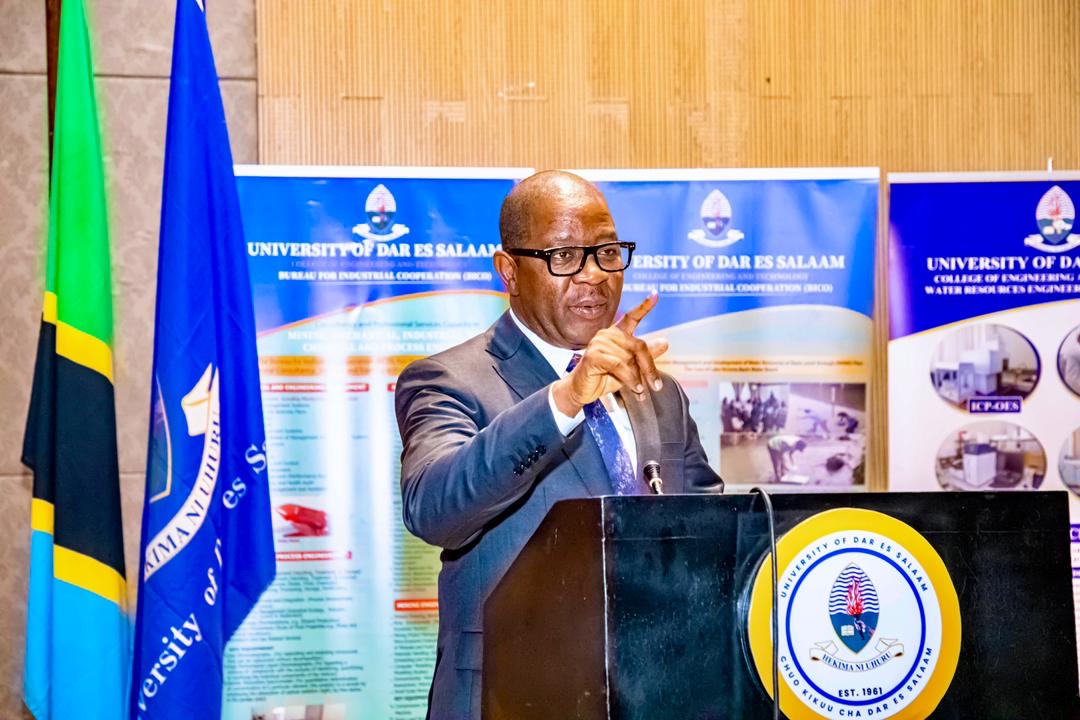

DAR ES SALAAM: MINISTER for Works, Abdallah Ulega has challenged university students, particularly those pursuing engineering and science programmes, to develop practical technological innovations to address persistent national infrastructure challenges.
Speaking during a visit to the University of Dar es Salaam (UDSM), where he met members of the Engineering Society at the College of Engineering and Technology (CoET) yesterday, he cited traffic congestion, affordable housing shortages and the recurring cycle of annual pothole repairs as areas requiring homegrown solutions.
“We want the country to obtain solutions through you scientists. The future of global development lies in scientists and innovators. Conduct more research, come up with innovations, and we will work on them,” he said.
Mr Ulega encouraged students to apply their academic knowledge to help the nation find lasting solutions to problems that continue to cost the government significant financial resources each year.
He revealed that upon his appointment, President Samia Suluhu Hassan asked why roads are repaired repeatedly instead of being constructed to last longer.
“When I was appointed minister, the president asked me why we repair the same roads every year. Why is there no technological innovation to permanently solve this problem? That question made me reflect deeply,” he said.
The minister explained that approximately 200bn/- are spent annually patching potholes on certain roads – funds that could be redirected toward other development projects if permanent solutions were implemented.
To encourage competition and creativity, Mr Ulega announced that students who submit outstanding and practical proposals addressing these challenges will share a total prize of 10m/- among the top three winners.
“You may write individually, in pairs, or as a group. If we are satisfied that your paper provides a realistic and implementable solution, we will award you publicly,” he said, adding that the goal is not merely to give prizes but to implement viable ideas.
ALSO READ: UDSM students emerge winners of grand prize in ICT global competition
Responding to students’ suggestions that they should be involved in implementing the projects they propose, the minister said the ministry would explore mechanisms to engage them in execution, giving them hands-on experience and the opportunity to see their ideas brought to life.
Tanzania National Roads Agency (TANROADS) Director of Infrastructure Planning, Engineer Ephatar Mlavi, noted a significant gap between local and foreign contractors in executing large infrastructure projects.
He said TANROADS plans to empower special groups, including youths, to access tenders for projects not exceeding 50bn/-, in line with the Public Procurement Act, to strengthen the capacity of local contractors. CoET Principal, Dr Innocent Macha said the expectation is for university graduates to become job creators rather than job seekers.
He said that young people must align themselves with the demands of the 21st-century labour market, which requires innovation, technological skills, and problem solving using modern approaches.
Dr Macha added that the era of waiting to be employed is over, and education should empower students to be self-reliant and establish ventures that drive national development.
He further stressed the government’s commitment to building an industrial economy in tandem with modern technology, noting that the contribution of engineers, scientists, and young innovators is crucial in realising this vision.
He urged students to use their knowledge to develop products, services, and systems that add value to the country’s resources and create new employment opportunities.