
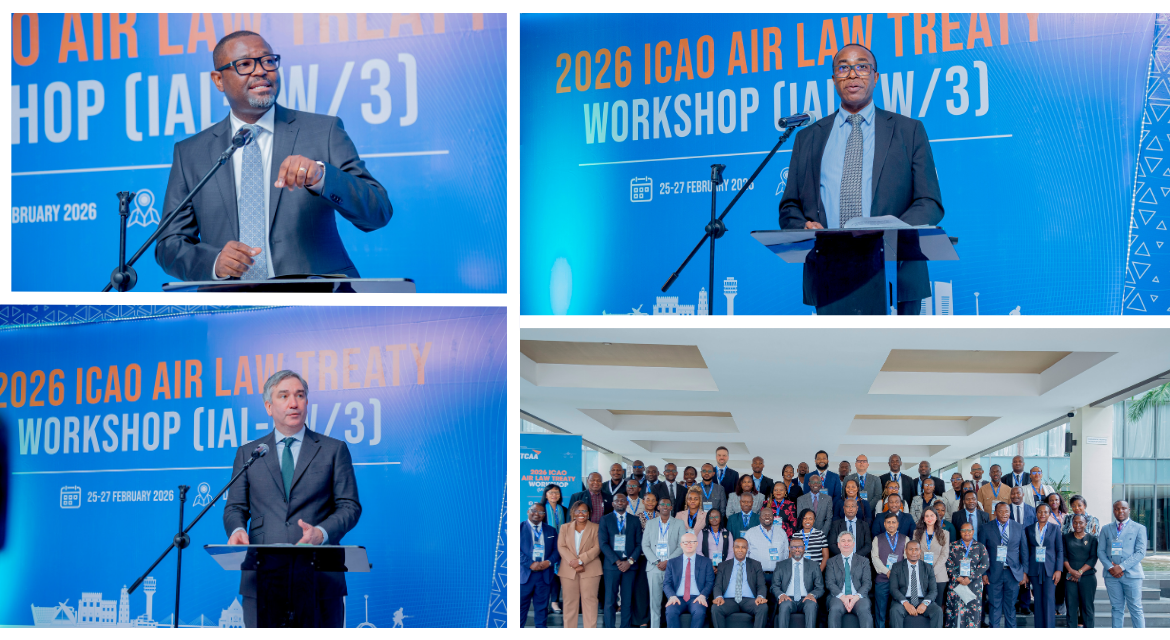

DAR ES SALAAM: THE government has stepped up calls for faster ratification and domestication of international air law treaties, saying a strong and coherent legal framework is essential to sustain the rapid transformation of the aviation industry.
The push comes amid sweeping technological shifts in global aviation, including the rise of Artificial Intelligence (AI), unmanned aircraft systems, digitalisation and growing cybersecurity threats, which are rapidly reshaping the industry’s operational landscape.
The Attorney General Mr Hamza Johari made the remarks yesterday while opening the 2026 Air Law Treaty workshop organised by the Tanzania Civil Aviation Authority (TCAA) in collaboration with the International Civil Aviation Organisation (ICAO).
“These developments present immense opportunities for innovation, but they also raise complex legal and ethical questions. We must therefore rethink how we legislate, regulate and enforce aviation laws,” he said.
He said that global aviation plays a pivotal role in connecting people, markets and cultures, driving economic growth, facilitating trade and tourism, and strengthening international relations. However, he cautioned that these benefits depend on a sound and harmonised system of international air law.
The three-day workshop intended to inform and update civil aviation and other related officials on the importance of air law treaties, highlighting benefits and obligations of States that become parties to international legal instruments as well as the ratification processes and tools to implement them.
The event brought together more than 150 participants, including about 70 delegates from international, outlining the benefits and obligations of states that become parties to international legal instruments, as well as the processes and tools required for ratification and implementation.
He said that effective air transport requires a robust legal system and that such international forums provide an opportunity to identify gaps, resolve legal challenges and ensure enforceability of aviation laws across jurisdictions.
TCAA Director General Salim Msangi described the workshop as a critical learning platform and a catalyst for local experts to assess which treaties Tanzania has yet to ratify and to expedite the process.
“As an aviation authority, we use this forum to better understand these treaties and facilitate their domestication into our national laws so that they can be effectively implemented,” Mr Msangi said.
The ratifying international conventions promotes what is known as uniform application of procedures and measures among contracting States, strengthening predictability and legal certainty in cross-border aviation operations.
ICAO’s Director of Legal Affairs and External Relations Bureau Mr Michael Gill underscored that ratification and implementation of international air law treaties remain central to ensuring safe, secure, regular and sustainable air transport worldwide.
“Over the next two days, delegates are expected to deepen their understanding of key legal instruments, share best practices and develop a collective action plan to strengthen implementation across the continent and beyond,” Mr Gill said.
He further noted that the ICAO Assembly has adopted a new strategic plan for 2026–2050, placing renewed emphasis on enhancing States’ legal capacity and harmonising aviation laws to respond to emerging global challenges.
He said since 1947, ICAO’s legal committee has developed 24 air law treaties forming the backbone of the global civil aviation legal framework anchored on the Chicago Convention, which recently marked its 80th anniversary.