
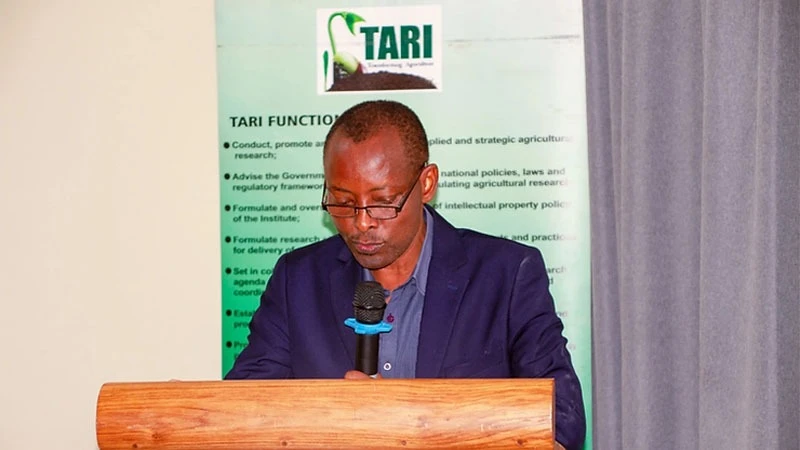

DODOMA: THE Government, the private sector and development partners have agreed to collaborate to ensure that farmers access quality seeds that meet market demands.
A statement published on the website of the Dodoma based Tanzania Agricultural Research Institute (TARI) said that after meeting in Arusha recently under the Accelerated Variety Turnover initiative, stakeholders have agreed to bridge the gap between researchers and produce traders in order to fast track agricultural transformation in the country.
The statement quoted TARI Director General, Dr Thomas Bwana, saying the agricultural sector is a key pillar of the National Development Vision 2050 and is expected to contribute up to 40 per cent of the Gross Domestic Product (GDP).
He stressed that these goals cannot be achieved if farmers continue using outdated seed varieties that do not align with market needs.
He noted that TARI has stepped up efforts to increase the production of improved seeds, revealing that in 2025 alone, the institute produced 125 tonnes of basic seed to address shortages in seed availability across the country.
On his part, Dr Chris Ojiewo from the International Maize and Wheat Improvement Centre (CIMMYT) said the ACCELERATE project was designed to address the mismatch between production and market demand.
He explained that previously, traders complained about the lack of quality seeds, while producers cited the absence of reliable markets.
Under the new system, traders are placed at the centre of the value chain to specify the type of crop required, farmers produce with assured markets and researchers develop seed varieties that meet those specifications.
ALSO READ: ASA doubles seed production as sector eyes climate resilience
Meanwhile, Director General of the Tanzania Official Seed Certification Institute (TOSCI), Mr Nyasebwa Chimagu, said the institute has begun transitioning to digital systems to improve service delivery.
He explained that seed registration will now be conducted online to reduce bureaucracy, while digital calendars are being introduced to monitor seed farms across the country.
He added that amendments to the Seed Act are underway to align with changing market dynamics.
Representing development partners, Mr Jean Claude Rubyogo of the PanAfrica Bean Research Alliance (PABRA) and Mr Jeffrey Ehlers of the Gates Foundation stressed that the success of agricultural research should not be measured by the number of new seed varieties developed, but by how they transform farmers’ livelihoods.
They urged the Government to continue strengthening the Quality Declared Seed (QDS) system to reach more farmers, particularly those in rural areas.