
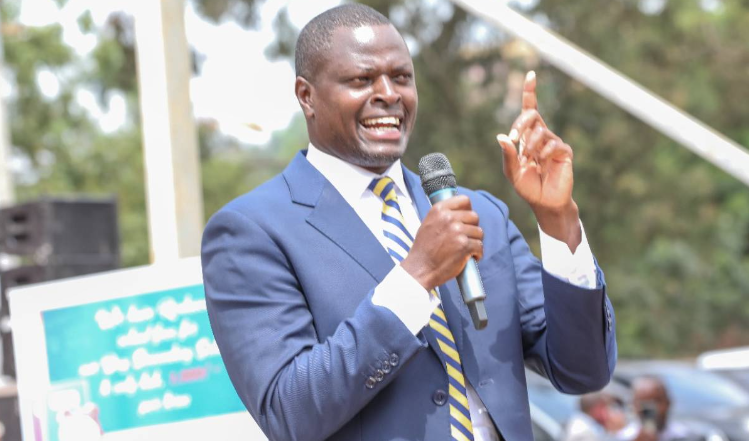

NAIROBI: THE economic issues in Kenya are not only disappointing to Kenyans, according to Ndindi Nyoro, a Member of Parliament (MP) for Kiharu Constituency in Murang’a County but also leaving economic analysts speechless as the days go by ahead of the 2027 general election.
It has been realised that the economic challenges Kenya is currently confronting particularly the issue of repaying its national debt are more severe than previously believed, following a careful listening to Mr Ndindi Nyoro and interpretation of his remarks.
What specific lessons have been acquired, from an economic analyst’s perspective, from Mr Ndindi?
Mr Ndindi Nyoro contends that Kenya is on the brink of an adverse economic trajectory, driven by the sale of strategic government assets, excessive borrowing and what he calls off-book financing mechanisms, concealed under new labels such as the Infrastructure Fund.
At the centre of his concerns is the claim that the government is prioritising shortterm political considerations particularly the 2027 elections over long-term economic sustainability to save Kenyans.
Mr Nyoro begins by warning that Kenya is currently borrowing approximately KSh 1.25 trillion per year in net terms, translating to about KSh 3.5 billion daily.
He contrasts this with former President Mwai Kibaki’s administration, which borrowed roughly the same amount over a ten-year period.
According to Nyoro, the pace and scale of current borrowing are unprecedented and unsustainable. He stresses that this figure excludes refinancing of old debt, meaning the actual gross borrowing is even higher.
In his view, such borrowing levels amount to fiscal recklessness that cannot continue indefinitely.
Mr Nyoro links this borrowing trend to what he describes as the quiet disposal of public assets. He cites the reported sale of the National Social Security Fund’s (NSSF) stake in East African Portland Cement to a Tanzanian-linked company, arguing that the asset was allegedly sold below its value.
Mr Nyoro questions why a foreign investor can perceive value in a local company that a domestic pension fund appears unwilling to retain.
For him, this represents a broader pattern of interference in NSSF’s investment decisions and a risk to Kenyans workers’ pension savings.
The MP for Kiharu Constituency in Murang’a County expands his argument by introducing what he calls a new term in town, the Infrastructure Fund.
In his interpretation, this fund is essentially a vehicle for two things: Selling government stakes in strategic companies, including Safaricom and undertaking more borrowing.
ALSO READ: Former leaders’ statements and the fate of Kenya’s economy towards the 2027 elections
He contends that despite the complex terminology, the substance remains either asset disposal at discounted prices or additional debt accumulation.
According to him, development spending in Kenya is increasingly being diverted outside the formal budget framework into alternative financing structures, thereby reducing transparency and parliamentary oversight.
A major concern he raises is securitisation, the practice of borrowing against future revenue streams. For noneconomists, this is a good research area.
Mr Nyoro claims that Kenya has already securitised future fuel levy collections, effectively collecting in advance taxes that were meant to finance road construction over the next seven years.
He argues that this means revenue that would have supported infrastructure in the future has already been spent today.
He also alleges that the housing levy is in the process of being securitised, which he describes as mortgaging future contributions in advance.
Mr Nyoro criticises Kenyan local financial institutions, particularly banks involved in these transactions, arguing that they are participating in collecting future tax revenues upfront.
In his view, this shifts fiscal burdens to future generations while creating the illusion of current development.
He insists that securitisation is effectively borrowing under a different name and claims it is legally questionable.
Using the example of a KSh 44.5 billion stadium project, Hon Nyoro argues that the headline cost does not reflect the true long-term burden.
According to his calculations, interest payments over 15 years would push the total cost to over KSh 140 billion.
He uses this example to illustrate how borrowing decisions multiply financial obligations over time, especially when driven by political urgency rather than economic prudence.
Mr Nyoro further warns that Kenya risks following the path of countries such as Senegal, Zambia, Sri Lanka and Ghana, where high debt levels led to restructuring or default.
He references cases where governments were forced to renegotiate debt, sometimes paying creditors less than the original amounts owed.
In his view, Kenya is heading down a similar slippery path if borrowing and asset sales continue unchecked.
Mr Nyoro further questions the logic of tolling roads such as the Nairobi–Nakuru highway while simultaneously borrowing heavily and selling government assets.
He argues that if the government is raising funds through debt and asset sales, it should use those funds to provide public infrastructure without imposing additional toll charges on Kenyan citizens who already pay taxes, VAT and fuel levies.
To him, tolling represents the state abdicating its responsibility to provide public goods.
Additionally, Mr Nyoro criticises what he sees as politically timed announcements of infrastructure projects.
He claims some road expansions were completed earlier but publicised closer to election periods to gain political advantage that doesn’t help Kenyans at all.
In his view, this demonstrates that economic decisions are being shaped more by electoral timelines than by rational fiscal planning.
Throughout his remarks, Mr Nyoro in my view, returns to three central themes: Unsustainable borrowing, the mortgaging of future revenues and the sale of strategic public assets.
He frames these developments as deliberate policy choices aimed at financing visible projects ahead of elections, even if they compromise long-term fiscal health.
He calls on Kenyans to remain vigilant and to scrutinise government financial decisions carefully because at the end of the day Kenyans are the ones who will be in trouble.
Much as not many Kenyans would like to face the truth, Hon Nyoro’s view on how the Kenyan economy is being managed presents a coherent warning that Kenya is accumulating debt at an alarming pace, increasingly relying on securitisation of future revenues and disposing of strategic state assets in ways that may undermine economic sovereignty.
For him as a member of the parliament, he states that unless fiscal discipline, transparency and long-term planning are restored, the country risks entering a debt crisis similar to those experienced by other developing economies.
Mr Nyoro’s whistleblowing, in my view, triggered a debate that touches the very core of Kenya’s economic governance.
At stake is not only the ownership of a cement-related firm but also the credibility of public asset management, the fairness of valuation processes and the security of workers’ pensions.
From an economic perspective, in times of fiscal pressure and economic adjustment, countries cannot afford governance ambiguities.
Pension funds represent intergenerational wealth. Their management must be insulated from opacity and perceived impropriety.