

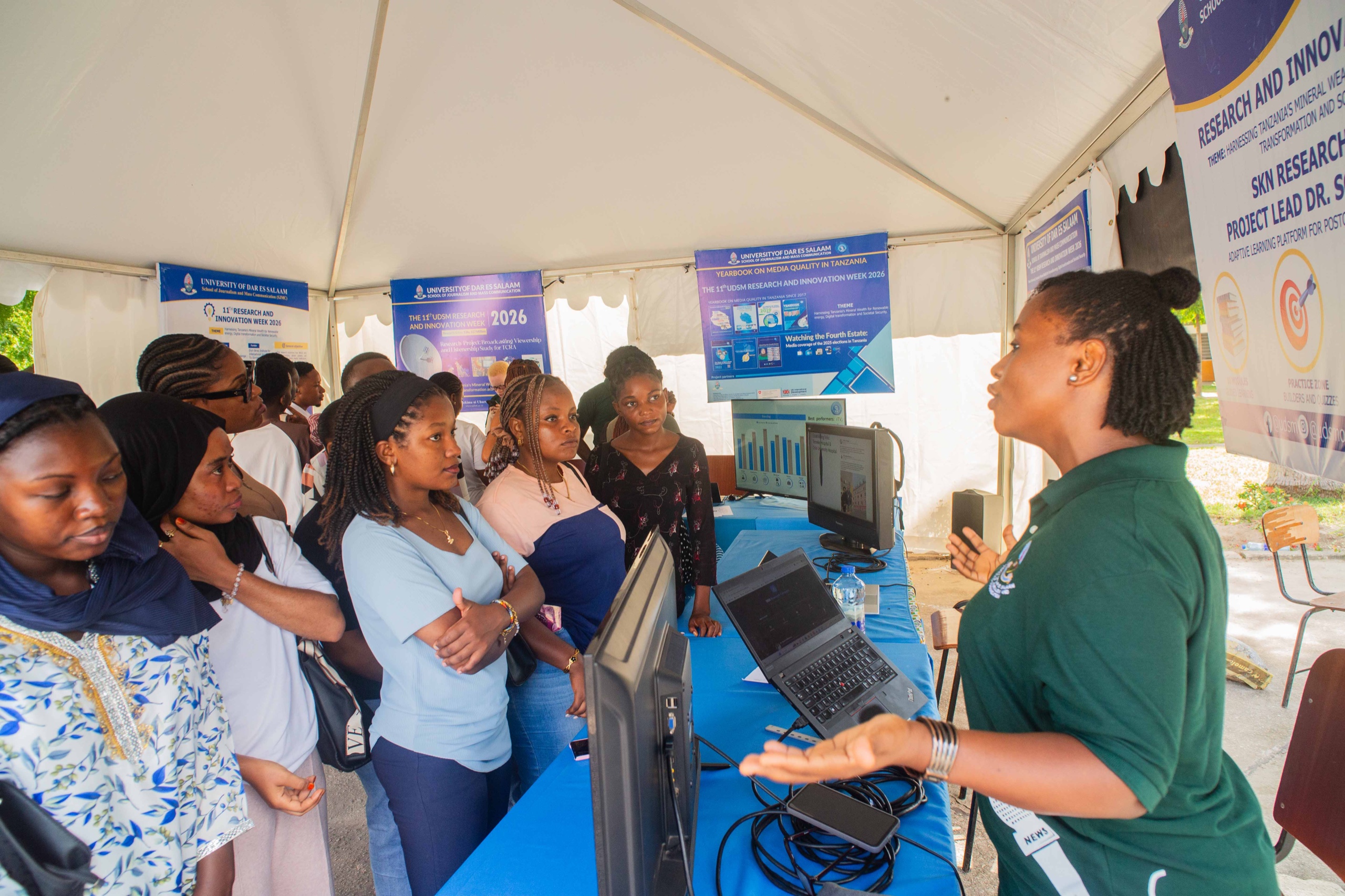
DAR ES SALAAM: A Lecturer at the UDSM’s School of Journalism and Mass Communication (SJMC), Dr Sophia Ndibalema has launched a “SKN Research Compass,” a digital learning platform designed to support postgraduate research students and their supervisors by simplifying the research process and improving the quality of academic output.
Speaking during the closing of the 11th University of Dar es Salaam (UDSM) Research and Innovation Week 2026 in Dar es Salaam today, May 21, 2026, Dr Ndibalema said the platform was developed in response to long-standing challenges faced by postgraduate students, particularly anxiety, lack of confidence, and limited understanding of research methodologies, which often delay or derail completion of studies.
According to Dr Ndibalema, who showed concern over students who have difficulties with research works, many of them struggle not because they lack intelligence, but because they are not adequately guided on how to develop research proposals, formulate research problems and apply research protocols effectively.
“I’ve been supervising students for more than 10 years, I would say. Postgraduate students, I started from undergraduates for more than 10 years. Postgraduate just recently, I think I have 4 to 5 years. After I finished my PhD, I started supervising postgraduate students. So I’ve seen a lot of challenges among the students, especially when they start with the research. When it comes to research, most of them have a lot of anxiety and they fear research,” she said.
Elaborating on how the newly launched app works, she said that the platform provides structured learning through modules covering the full research cycle, from topic identification and problem formulation to literature review and methodology, supported with practical examples drawn from the Tanzanian context to enhance relevance and understanding.
“I’ve used our context, the Tanzanian context. So most of the examples they will find, they will be talking about areas which are in Tanzania, they will be talking about companies which are in Tanzania, and data which is available in Tanzania. Just to get that feeling that this platform is for us or it relates to what they are,” she said.
ALSO READ: Serengeti’s balloon safari, great wildebeest migration fascinate Man United legend
Additionally, she said that the system includes a digital library of academic resources and theories, mainly focusing on communication, public relations, strategic communication and corporate social responsibility, while also allowing interdisciplinary access to other fields such as gender studies and psychology.
Unlike conventional AI tools, she emphasized, SKN Research Compass is designed as an interactive learning assistant that guides students step by step, asking questions and helping them build their own research work rather than generating ready-made outputs.
Moreover, she also revealed plans to introduce a personalized AI tutor that will further enhance student engagement by offering guided, question-based learning.
“So I came up with a platform that would help these students to learn at their own pace on how they can conduct research. With the aim that the output we get from the research that is done by our students at the postgraduate level is of high quality. But also the postgraduate students themselves feel confident about their work,” she said.
Adding, she said; “Right now with AI, it’s a challenge. What happens, most of the students would use AI tools, I don’t know how to describe it, as a tool which would just do it all. To do their work.I cannot do this research, I’m running out of time, this is my research area, please just produce a research proposal. It does for you, right? But in the end, is that your work? Will that research help us in the field? Probably not. But this platform enables the students themselves to have time or to learn at their own pace on how they can do their research and confidently own their work.”
In addition, Dr Ndibalema said the platform is continuously evolving, currently in its 17th version, shaped by user feedback, including accessibility improvements following concerns raised by visually impaired users.
Reflecting on its development journey, she said the system was built largely through self-driven innovation supported by artificial intelligence tools, despite her not having formal programming skills, highlighting how technology can empower academic innovation.
Dr Ndibalema added that the platform, though still in its early stages, has already attracted initial users including postgraduate students and academic supervisors, with interest extending beyond Tanzania to international users exploring the trial version.
Moreover, she said that the platform can be used by students across disciplines in social sciences and related fields, and has potential for wider institutional adoption if universities subscribe collectively to support its expansion.
According to her, institutional partnerships would not only improve access for students but also enhance research quality while reducing the supervisory burden on lecturers.
A third year student from the university studying Public Relations and Advertising, Dominc Mgaya commended the newly launched app saying it has come at the right time when students face big challenge in research writing
According to the students, most students relied on Chat GPT and AI while others used other sources in writing research but couldn’t produce a quality research work that could be understood or make any sense.
“This is a program that will help us students a lot when we are doing research because we were lacking the right guidance to guide us when we are doing research because everyone was looking for the one who has the sources they trust. At the end of the day, people create something that is not of good quality. But looking at the entire project, this software has a very good guide where from the beginning a person starts to generate a statement of the problem until they reach the point of collecting data,” he said.
The students added; “Students had to go to chatgpt, use them either to guide them or to do research, but at the end of the day you find that what you are getting does not match the person’s level of education. You will find a postgraduate student who has done research and has reached the end but when you look at it, you do not see or get the meaning of the research he did, so I think going through this software will be a great help to students. It is for postgraduate students, but from what I have seen, as an undergraduate student, it can help me somewhat in preparing my research so that it can be better.”