

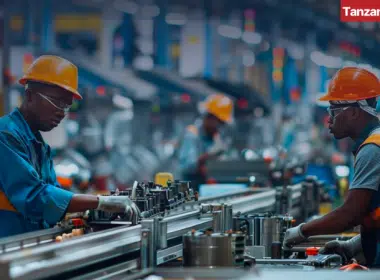
DAR ES SALAAM: TANZANIA’S industrial drive is beginning to shift the balance of trade, with new factories expected to reduce reliance on imported goods while expanding the country’s export capacity.
The shift is being driven by a new wave of factories producing electrical cables, protective clothing, veterinary medicines and construction materials, marking a gradual diversification beyond traditional industries such as cement, sugar and steel.
Officials say the expansion is aimed at strengthening local value addition and positioning manufacturing as a key pillar in export-led growth. Many of the factories are targeting markets across East and Southern Africa while seeking to reduce reliance on imported industrial goods.
Minister for Industry and Trade, Ms Judith Kapinga, said in the 2026/27 budget speech in Dodoma that 25 new medium and large-scale factories began operations in 2025/26, generating 39,250 jobs as part of the government’s broader strategy to deepen value addition and reduce dependence on imports.
ALSO READ: AfDB urges bold financial reforms to unlock Africa’s potential
The new investments span multiple sectors, reflecting a policy shift toward diversification beyond traditional manufacturing into higher-value industries linked to energy, construction, agribusiness and consumer goods.
Ms Kapinga said the objective is to strengthen domestic production while positioning Tanzania more firmly within regional and global supply chains.
Among the latest entrants are firms such as Afriport Apparel, which produces industrial protective clothing in Dar es Salaam and Giant Group Co. Ltd, a manufacturer of electrical cables in the Coast Region. Other newly commissioned facilities include producers of mattresses, veterinary medicines and construction materials, underscoring the widening scope of Tanzania’s industrial base.
Yet despite the visible expansion in factory numbers, data suggests the industrial sector is still struggling to convert capacity into sustained output. Many of the new plants are operating below installed capacity, reflecting early-stage production constraints as firms scale operations and integrate into supply chains.
The government’s figures show that manufacturing’s contribution to GDP declined to 5.9 per cent last year from 6.8 per cent in 2024, even as the sector recorded growth of 5.2 per cent compared with 4.9 per cent in 2024. The Minister said the government’s industrial strategy is anchored on import substitution and export expansion, with new factories increasingly targeting markets across East and Southern Africa.
The aim, she said, is to reduce reliance on imported industrial goods while boosting domestic value addition through locally sourced raw materials. Imports rose to 16 billion US dollars last year, compared with 10.08 billion dollars in exports, leaving a persistent trade deficit driven largely by purchases of machinery, fuel, transport equipment and industrial inputs.
The widening gap reflects the country’s ongoing dependence on foreign capital goods even as it seeks to build domestic production capacity. While industrial policy is increasingly focused on substitution, the economy remains structurally reliant on imports to sustain manufacturing expansion. At the same time, export performance has shown notable improvement, particularly in regional markets.
Sales to the European Union rose 37.5 percent in 2025, while exports to the Southern African Development Community increased 19.4 percent, driven by both agricultural commodities and early-stage manufactured goods.