
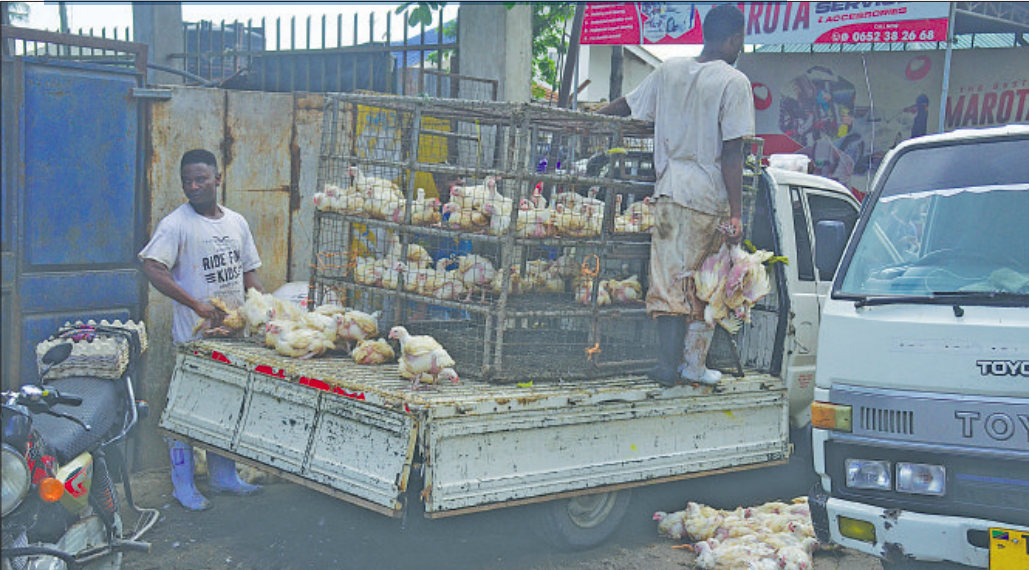
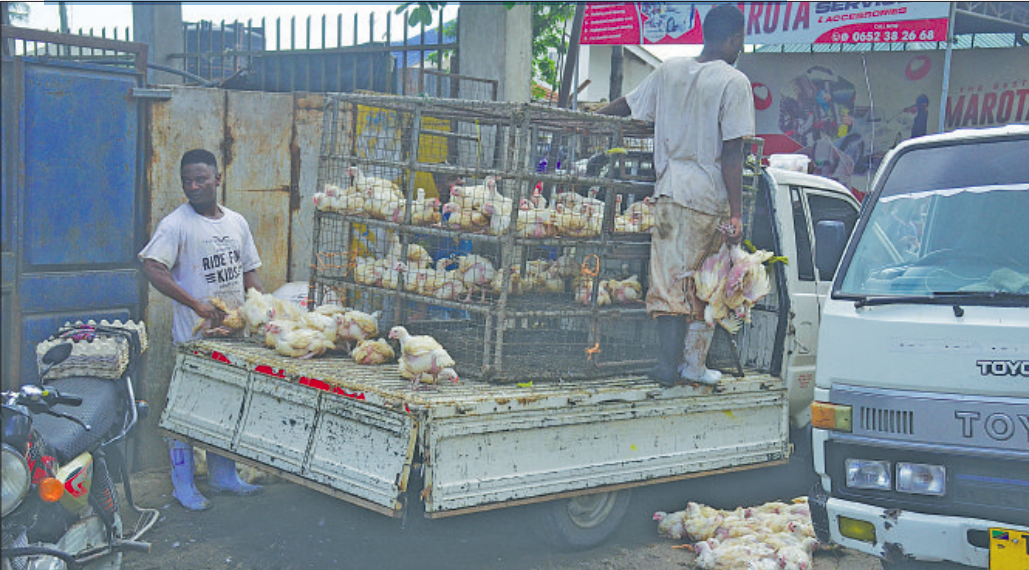
DAR ES SALAAM: ANIMAL feed accounts for the largest share of poultry production costs, making it one of the biggest challenges facing Tanzania’s fast-growing poultry industry.
Seeking to address that problem, Tanzanian researcher and entrepreneur Dr White frank Frank has spent nearly a decade developing a poultry feed formulation that he says can lower production costs by about 20 per cent while maintaining commercially acceptable growth rates in broiler chickens.
The product, developed through Afrimix Animal Feeds, is the outcome of eight years of research aimed at reducing one of the industry’s most significant expenses.
The company plans to enter a market where feed prices have risen steadily, squeezing margins for both small-scale and commercial farmers
According to Dr Frank, feeding trials indicate that the formulation enables broiler chickens to attain market weights while lowering overall production costs.
The company intends to compete primarily on price. While established poultry feed brands typically retail for between 80,000/- and 110,000/- per bag, depending on product category and quality, Afrimix plans to sell its feed for between 70,000/- and 75,000/- per bag.
“Our objective is to maintain quality while reducing production costs for farmers,” he says.
The feed relies largely on locally sourced ingredients, a strategy the company believes could help farmers reduce dependence on costly commercial and imported inputs while improving profitability.
For Dr Frank, the venture forms part of a broader effort to use science, technology and entrepreneurship to solve practical business and social challenges.
Through Afrimix Animal Feeds and Innovate Africa Technologies Limited, he is pursuing projects in agriculture, digital health, financial technology and renewable energy.
The idea for Afrimix emerged from personal experience. Raised in a livestock keeping environment, Dr Frank witnessed the pressures facing farmers as input costs increased and profit margins narrowed.
As poultry demand expanded across the country, he observed that many producers struggled to convert growing market opportunities into sustainable returns.
Research involving both commercial and traditional poultry farmers pointed to feed and veterinary expenses as the primary obstacles to profitability.
ALSO READ: High feed prices drive poultry farmers out of business
Farmers were spending heavily on day-old chicks, feed, vaccines and disease management, leaving limited room for earnings.
“Having grown up in a livestock-keeping environment, I witnessed these challenges firsthand,” says Dr Frank.
“That experience inspired me to look for practical solutions that could improve productivity while reducing costs.”
The search for a solution evolved into a research programme focused on developing nutritionally balanced poultry feed using locally available raw materials.
A significant milestone came in 2021 when Dr Frank secured an initial grant of 5,700 US dollars through the MAKISATU programme coordinated by the Ministry of Education, Science and Technology.
The funding enabled further product development and scientific validation.
Working with researchers from Sokoine University of Agriculture (SUA), the team conducted feeding trials involving 800 broiler chicks to assess growth performance and production economics.
According to Dr Frank, chickens fed with the formulation reached market weights of between 1.5 and 2 kilogrammes within commercially acceptable production periods, while production costs declined by roughly 20 percent compared with some conventional feeding systems.
He adds that broiler chickens fed using the formulation are capable of reaching market-ready weights within approximately three weeks under proper management conditions, enabling farmers to bring birds to market faster.
The innovation comes as the country’s poultry sector continues to expand.
Presenting the Ministry of Livestock and Fisheries budget for 2026/27, Minister for Livestock and Fisheries Ambassador Bashiru Ally said the country’s poultry population has continued to grow, supported by investments in hatcheries, breeder farms and disease-control programmes.
Tanzania currently has 27 poultry breeding farms, including 25 parent-stock farms and two grandparent-stock farms, alongside 28 hatcheries.
By April 2026, the country had produced, distributed and sold 83.9-million-day-old chicks domestically and internationally.
The total included 70.5 million broiler chicks, 10.3 million improved indigenous chicks and 3.1-million-layer chicks. Local breeding capacity has also reduced dependence on imports.
Breeder chick imports declined from 1.16 million birds in 2024/25 to 1.03 million in 2025/26, while exports of dayold chicks increased from 1.9 million to 5.75 million during the same period.
Despite the sector’s growth, productivity challenges continue to constrain profitability.
Dr Frank argues that one issue requiring greater attention is the widespread practice of selling chickens by number rather than by weight.
“If farmers are rewarded according to weight, they will be more motivated to adopt innovations that improve productivity and quality,” he says.
Afrimix is now preparing for commercial production in collaboration with the Tanzania Commission for Science and Technology (COSTECH).
Although the product has yet to be launched officially, the company sees substantial room for expansion.
Dr Frank estimates that approximately 60 per cent of demand in Tanzania’s poultry feed market remains unmet, creating opportunities for local manufacturers. Afrimix plans to begin distribution in Dar es Salaam, Coast Region and Morogoro before expanding into Dodoma, Singida, Kilimanjaro and Arusha.
He also believes many poultry farmers can improve performance through better nutrition and management practices.
“Many farmers have been led to believe that chickens must be fed a specific type of feed,” he says.
“In reality, what matters most is following good farming practices and ensuring birds receive balanced nutrition containing the right nutrients.”
As the company moves toward commercialisation, Dr Frank says additional private sector investment will be needed to scale production and broaden access to affordable feed solutions.
“We want to build companies that solve real problems. If we can help small-scale farmers become more profitable, we are also contributing to private sector growth, food security and national development,” he says.
With feed costs remaining the largest expense for poultry producers, innovations that lower input costs while maintaining productivity could play an increasingly important role in the next phase of Tanzania’s poultry industry growth.