
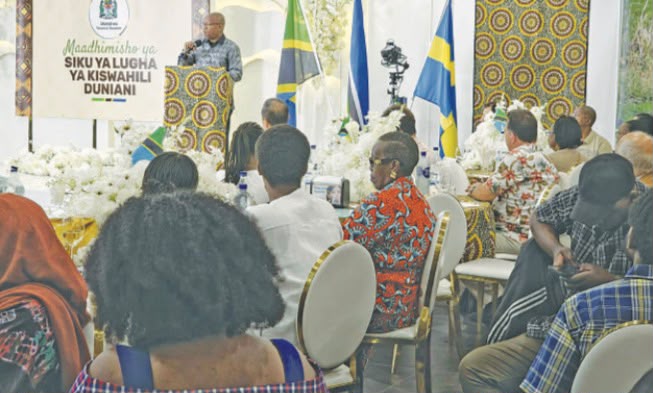
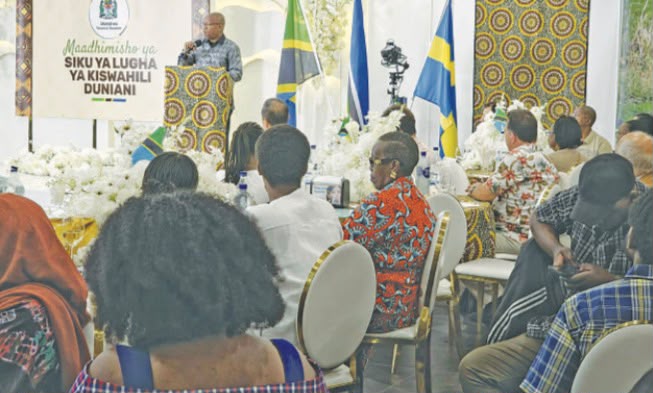
TANZANIA: ORIGINATING along the shores of the Indian Ocean, particularly Unguja and its surrounding islands, Kiswahili has grown from a regional means of communication into one of Africa’s most influential languages. Having spread across mainland Tanzania, East and Central Africa and beyond, the language is increasingly gaining recognition across the world.
Today, Kiswahili is far more than a medium of communication. It has become a powerful instrument for promoting economic development, strengthening international relations and advancing global diplomacy, while remaining the cornerstone of Swahili culture and Tanzanian identity.
Its growing international stature has placed it alongside major world languages in diplomacy, education, literature, trade and cultural exchange. The language’s global recognition was further reinforced when the United Nations Educational, Scientific and Cultural Organisation (UNESCO) designated July 7 as World Kiswahili Language Day, making it the first African language to receive such recognition.
As Tanzania continues to champion Kiswahili internationally, the country is preparing to host the Second International Kiswahili Conference at UNESCO headquarters in Paris, France, from July 4 to 7, 2026. The conference follows the inaugural gathering held in Havana, Cuba, in 2024 and is expected to bring together scholars, policymakers, cultural ambassadors, investors and members of the Tanzanian diaspora from around the world.
Speaking during a live television interview, the Executive Secretary of the National Kiswahili Council (BAKITA), Ms Consolata Mushi, said hosting the conference in France reflects the language’s growing international recognition and influence.
She said UNESCO’s decision to establish World Kiswahili Language Day demonstrates that the language is no longer viewed simply as a tool for communication but also as a driver of economic development, cultural identity and international diplomacy.
Ms Mushi cited President Samia Suluhu Hassan’s recent visit to Russia as a clear example of Kiswahili’s growing diplomatic significance. Despite being asked questions in English, the President responded in Kiswahili, a decision that, according to Ms Mushi, demonstrated the language’s ability to serve effectively on the global stage.
“President Samia Suluhu Hassan has truly done justice to Kiswahili. She deserves to be commended, celebrated and recognised as an example for all of us to follow,” she said.
According to Ms Mushi, Kiswahili has evolved beyond its traditional role as Tanzania’s national language to become an international language that continues to connect people and support development across different sectors.
She said the Paris conference also reflects Tanzania’s determination to promote its language and culture globally.
“This is the first time Tanzania has taken such a significant Kiswahili delegation to Europe, and it reflects our leaders’ vision and commitment to elevating the status of our language,” she said.
Emphasising the close relationship between language and culture, Ms Mushi noted that the conference will showcase Tanzania’s rich cultural heritage through traditional attire such as the kanzu and kanga, indigenous cuisine, traditional dances and musical genres including singeli and taarab.
The conference will also provide Tanzanians living abroad with an opportunity to engage with national leaders and discuss practical strategies for promoting Kiswahili internationally.
More than 150 members of the Tanzanian diaspora from different continents have already registered to participate and are expected to contribute ideas on expanding the language’s global presence.
Ms Mushi encouraged Tanzanians and Kiswahili enthusiasts across the world to participate in the conference and support efforts to promote the language internationally.
Beyond celebrating language and culture, the conference will also highlight Tanzania’s investment and business opportunities.
The Assistant Director for Language Development in the Department of Culture under the Ministry of Culture, Arts and Sports, Dr Resani Mnata, said the country’s leadership, particularly President Samia, has played a significant role in elevating Kiswahili by confidently using it during major international conferences and high-level meetings.
He said the President’s example demonstrates that Tanzanian leaders have confidence in their own language.
“There is a widespread misconception that speaking English or French is the ultimate mark of education. The truth is that Kiswahili possesses every qualification required of an international language,” he said.
Dr Mnata encouraged other leaders to follow the President’s example by using Kiswahili on international platforms and highlighted the important role of young people in promoting the language.
He cited the Best Player at the CAF Under-17 Africa Cup of Nations, who chose to answer interview questions in Kiswahili despite being addressed in English and French.
“That decision shows that the younger generation is proud of its language,” he said.
Dr Mnata said more than 32 academic papers covering economic and scholarly issues will be presented during the conference, while government institutions will showcase investment opportunities and areas of cooperation with their European counterparts.
Delegates will also experience Tanzania’s rich cultural heritage through traditional clothing, authentic Swahili cuisine and cultural exhibitions, further demonstrating the country’s rich identity and tourism potential.
Speaking on Kiswahili’s diplomatic importance, Dr Mnata said members of the Tanzanian diaspora continue to play a vital role in promoting the language abroad. Kiswahili teachers from the diaspora have already taught more than 600 students in 11 countries, while universities across Europe, the United States and other parts of the world continue to expand Kiswahili programmes.
“Many say they want to learn Kiswahili because it is Africa’s language, and they believe that speaking it will enable them to communicate easily and connect with the culture when they visit the continent,” he said.
According to Dr Mnata, the Paris conference represents a historic opportunity for both Tanzania and the Kiswahili language.
“The conference will reaffirm that Kiswahili is not simply another language. It is a powerful instrument for political, economic, social and cultural development, as well as a vital tool for strengthening diplomacy among nations,” he said.
ALSO READ: Tanzanian Embassy in Namibia receives KOHA, a digital system promoting Kiswahili globally
The Commissioner for Culture in Zanzibar’s Ministry of Information, Youth, Culture and Sports, Dr Omar Salum Mohamed, described Kiswahili as not only a language but also an important economic asset.
He said the language places Tanzania in a stronger position to attract investment, particularly in tourism and the blue economy.
“The philosophy of the blue economy can be promoted far more effectively through our Kiswahili language,” he said.
According to Dr Mohamed, leading private sector investors will join Tanzania’s delegation to France to explore business opportunities and establish partnerships with European investors.
“This demonstrates that Kiswahili is an instrument for economic development, not only within Tanzania but across the international community,” he said.
Dr Mohamed observed that Kiswahili continues to expand well beyond East and Central Africa. Countries such as Cuba and the Czech Republic, together with universities across Europe and the United States, are attracting increasing numbers of students eager to learn the language.
He added that the conference will feature an exhibition celebrating Swahili culture, displaying traditional artefacts such as lanterns, coconut graters and woven mats that reflect the everyday life of the Swahili people.
Visitors will also experience Tanzania’s cultural heritage through traditional clothing, henna art, music and cuisine, highlighting the enduring global appeal of Swahili culture.
As Tanzania prepares to showcase Kiswahili on one of the world’s most prominent international platforms, the Paris conference is expected to reinforce the language’s growing role as a vehicle for diplomacy, economic cooperation, cultural exchange and sustainable development. More than a symbol of national identity, Kiswahili is increasingly becoming a global language connecting people, cultures and opportunities across continents.