
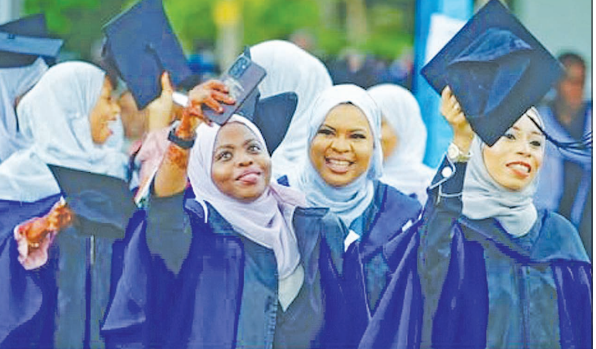
ZANZIBAR: AS Zanzibar steadily advances toward a more gender-equal and inclusive society, the role of universities in shaping tomorrow’s leaders is becoming increasingly vital. These institutions are not just centres of learning, they are spaces where dreams take root, talents are nurtured and leadership is forged.
Education stakeholders and governance experts agree that universities have the potential to become powerful incubators of a new generation of leaders who believe that leadership is not defined by gender, social status, or disability. Inclusive leadership, they argue, is not merely a moral imperative but a practical necessity.
Research consistently shows that institutions with diverse leadership make more balanced and effective decisions. Women bring unique lived experiences, while persons with disabilities offer perspectives often overlooked in mainstream policy discussions. When these groups are excluded from decision-making tables, their needs risk being sidelined.
This is why increasing representation is not just about meeting quotas, it is about building institutions that serve all citizens fairly.
Despite women making up more than 51 per cent of Zanzibar’s population, according to the 2022 Population and Housing Census, their representation in leadership positions remains at around 38 per cent. This disparity is also reflected within universities, where women and persons with disabilities are increasingly accessing higher education, but remain underrepresented in leadership roles.
At the Zanzibar University (ZU), an analysis of student government leadership shows that out of 30 leadership positions, only one is held by a person with a disability. In terms of gender, 14 positions are held by women and 16 by men.
At the State University of Zanzibar (SUZA), the imbalance is even more pronounced: Among 12 ministerial positions in the student government, none is occupied by a person with a disability, while only four are held by women compared to eight by men.
Among 15 deputy minister positions, only three are held by persons with disabilities, with six women and nine men. “These figures reflect deeper historical, social and cultural barriers that continue to limit women’s full participation in decision-making,” said Ms Nairat Abdulla Ali, Executive Director of TAMWA Zanzibar. “We must continue building their confidence and leadership capacity.”
For many students from marginalised groups, representation is transformative. Seeing someone like themselves in leadership positions breaks psychological barriers and reinforces the belief that leadership is not reserved for a select few, but is open to anyone with vision, integrity and commitment.
At Zanzibar University, one such trailblazer is Fauzia Rajab Shaabani, the Minister for Student Welfare and Special Needs. In her short time in office, she has emerged as a strong advocate for students with disabilities identifying their challenges, amplifying their voices and pushing for solutions.
Ms Fauzia has spearheaded the establishment of a Students with Disabilities Club and strengthened collaboration with organisations working on inclusive development. Her mission is clear: No student should be left behind because of their condition.
“We want students with disabilities to feel that they are part of the university community just like everyone else. When they step forward, they will participate in decision-making and eventually gain the confidence to become leaders of tomorrow,” she said.
Beyond campus, Fauzia has built partnerships with other student governments, relevant ministries, and development stakeholders to expand opportunities for the students she represents.
Zanzibar University Student Government President, Juma Omar, describes Fauzia as living proof that leadership transcends gender and disability. “We do not need others to speak on behalf of persons with disabilities. We need them to be leaders themselves and participate directly in decision-making. Fauzia has shown that this is possible,” he said.
Similarly, the university’s Student Government Judge, Azwar Said Mohammed, praised her relentless pursuit of knowledge and solutions.
“She does not see leadership as the end of the journey, but as an opportunity to solve problems. She actively seeks knowledge beyond the university by engaging with legal experts, institutional leaders and development partners,” he noted.
For Aisha Suleiman Ali, a student with albinism studying economics at ZU, Fauzia’s leadership has been life-changing.
“For a long time, I never imagined myself in leadership due to lack of confidence. But seeing Fauzia lead has changed my mindset. Today, I believe I can also run for a leadership position,” she said.
Her words highlight the power of representation: How one leader breaking barriers can inspire many others to step forward.
Efforts to close the leadership gap are also being driven by targeted interventions. The Tanzania Media Women’s Association (TAMWA Zanzibar) is implementing the Women Leadership for Equality, Accountability and Democracy (W-LEAD) project, which equips women and persons with disabilities with leadership skills, governance knowledge and tools for democratic participation.
According to TAMWA Zanzibar Monitoring and Evaluation Officer, Mohammed Khatib Mohammed, the initiative aims to challenge long-standing societal perceptions that leadership is a male domain.
“We want to empower young women to build confidence, contest for leadership positions and actively participate in decision-making systems,” he said.
Ms Nairat Abdulla Ali added that effective implementation of W-LEAD could significantly reduce gender disparities in leadership and ensure equal participation in development processes. Meanwhile, Ms Rukia Saleh Ali, from the Zanzibar National Association of the Blind (ZANAB), emphasised the importance of collective action.
“Closing the leadership gap requires joint efforts. We must empower women and persons with disabilities to actively participate in decisions that shape society,” she said, adding that ZANAB will continue working with TAMWA to ensure the project achieves meaningful impact.
These initiatives align closely with global commitments such as the Sustainable Development Goals (SDGs), particularly Goal 5 on gender equality and Goal 10 on reducing inequalities. They also reflect the priorities of UN Women, which advocates for inclusive governance and equal participation of women in leadership as a cornerstone of sustainable development.
While progress is evident, stakeholders acknowledge that significant work remains. Universities are being urged to strengthen leadership training for women and persons with disabilities, create more inclusive learning environments and establish systems to track representation in decision-making bodies.
Experts stress that real transformation will not come from empowering marginalised groups alone, but also from changing societal attitudes about who qualifies to lead.
ALSO READ: Creating safer digital spaces for women
The true measure of progress, they say, will be the day when a female student or a person with a disability stands for leadership, and is judged not by gender or condition, but by their ideas and policies.
That journey may begin in a single classroom, a student government, or one university, but its impact could reshape the future of leadership across Zanzibar and Tanzania as a whole.