
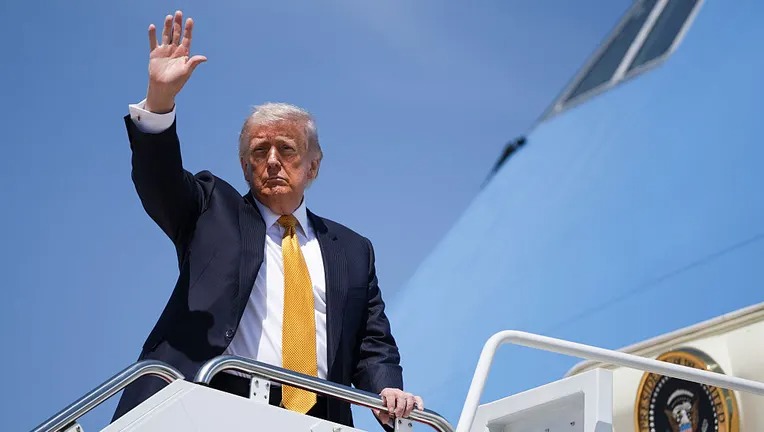
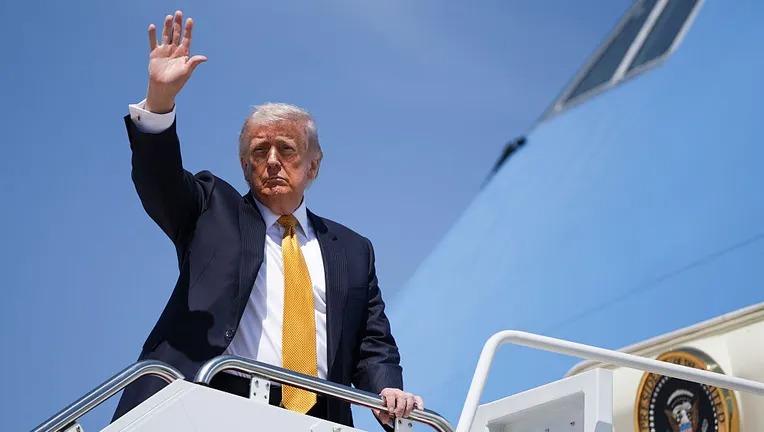
BEIJING: THE entire world will be watching Beijing, China, this week and possibly into next. Despite ongoing trade and economic challenges caused by energy supply instability, US President Donald Trump is set to visit China.
This trip is being viewed from different perspectives, depending on the angle taken.
President Donald Trump’s upcoming visit to Beijing this week is shaping up to be one of the most important geopolitical and economic meetings of the decade.
The summit with Chinese President Xi Jinping is taking place amid heightened global economic tensions: unrest in the Middle East, concerns over the Strait of Hormuz, slowing international trade, technological rivalry, energy anxieties, inflation concerns across nations and the growing fragmentation of the global trade and economic system.
While leaders do pay state visits across the world from time to time, this is not just a diplomatic visit; it is a strategic negotiation shaping the future of the global economy, trade systems, energy security, technology supply chains and geopolitical power dynamics.
While it may be left open, I believe that markets, governments, investors, multinational corporations and emerging economies are paying close attention to this meeting’s results because the outcomes could significantly impact global economic stability for years ahead.
The summit’s primary objective, unlike events such as the Africa-France Partnerships for Innovation and Growth in Nairobi this week, is to pursue the potential partial stabilisation of US-China trade relations, which have implications beyond the borders of the two nations.
Since the rise in tariff conflicts, global supply chains have been significantly reorganised.
Actions like tariffs, export controls, semiconductor restrictions and strategic competition have disrupted manufacturing supply chains and increased uncertainty for global businesses.
Although economic ties remain strong, political conflicts still prevent the full normalisation of trade relations between powerful nations and their trading partners.
Recent indications show that Washington and Beijing are prioritising managed stability over direct economic confrontation.
Experts believe the summit will aim to extend the current trade truce, prevent the reintroduction of punitive tariffs and foster a more stable global business environment.
China especially wants guarantees that tariff increases will not restart, whereas the US is seeking improved market access, better trade balances and collaboration on strategic supply chains.
Therefore, the world should anticipate a carefully negotiated outcome rather than a sudden breakthrough. A probable scenario involves a broad framework agreement focused on preserving economic stability while deferring more complex structural disagreements to future talks.
This kind of outcome would still be viewed favourably by global financial markets, as companies tend to prioritise predictability over the quick resolution of conflicts. Energy security is likely to be a key focus of the summit.
The ongoing conflict in Iran and instability near the Strait of Hormuz have greatly altered global strategic considerations.
ALSO READ: Trump lands in China for Xi summit with Nvidia CEO in tow
China, which powers the world economy in various ways, still relies heavily on energy imports from the Middle East, with a large share of its crude oil transiting through the Strait of Hormuz.
Meanwhile, the United States aims to leverage China’s diplomatic influence to ease tensions with Iran and restore stable maritime energy routes.
Strategically, this situation creates an unusual geopolitical dynamic in which Washington may require Beijing’s cooperation more than in past confrontations.
I am of the view that Trump will approach the summit under pressure to manage energy market disruptions, which have driven up oil prices and heightened inflation concerns worldwide.
At the same time, China aims to prevent a sustained energy crisis that could reduce global demand and negatively impact export markets.
Consequently, the summit might foster indirect cooperation on Middle East stability, maritime security and energy trade.
If effective, this could stabilise global oil markets and alleviate concerns about a sustained global economic slowdown.
For emerging economies like Tanzania and other African nations, this is highly significant, as energy price shocks directly influence inflation, transportation costs, industrial output, exchange rate stability and the ability to raise sufficient resources to pay debts.
A key expectation also involves technology and strategic industrial rivalry. Recently, the competition between the United States and China has focused more on semiconductors, artificial intelligence, rare earth minerals, digital infrastructure and advanced manufacturing.
Export controls and technology restrictions have accelerated the fragmentation of global technology systems. However, both nations recognise the significant economic consequences of unchecked decoupling.
Recent talks suggest that the summit might involve negotiations to relax certain restrictions on rare earths, energy trade and specific industrial sectors that, through the supply chain, are linked to raw material-exporting nations.
The world should therefore anticipate selective economic cooperation alongside ongoing strategic rivalry. In practical terms, this means competition will persist in AI, semiconductors and military technology, while economic cooperation may expand in energy, agriculture, aviation and climaterelated investments.
This explains why several major American business executives are reportedly accompanying Trump to Beijing, including leaders connected to aviation, technology, finance and manufacturing sectors.
The summit’s economic outcomes are expected to include large commercial agreements.
China might boost its purchases of American agricultural products, aircraft, energy supplies and industrial goods to reduce trade tensions and stabilise economic relations.
Possible agreements under consideration include deals with Boeing, energy export arrangements and agricultural purchase commitments.
If such deals come to fruition, they would indicate that both countries are working to restore targeted economic interdependence instead of seeking total separation.
This could boost global commodity markets, shipping activity, manufacturing confidence and investor sentiment.
The summit is also highly significant for global financial markets, providing reasons to be here at the right time for this historic visit.
Investors are increasingly concerned about the risk of simultaneous geopolitical and economic shocks including war-related energy disruptions, inflation persistence, slowing Chinese growth, rising debt vulnerabilities and global trade fragmentation.
Hence, in my view, a successful summit that lowers tensions could trigger improved investor confidence, stronger equity markets, stabilisation of commodity prices, reduced volatility in global trade and renewed capital flows into emerging markets.
On the other hand, a failed summit or escalation of Taiwan-related tensions could trigger severe market reactions, particularly in energy markets, technology stocks, shipping and Asian currencies.
Although some non-analysts may view it as a concern, Taiwan remains arguably the most sensitive and strategically risky issue on the agenda.
China sees Taiwan as a core national interest and has repeatedly opposed increased US military and political backing for Taipei.
Beijing is likely to push for lowering US arms sales and adopting a more cautious tone on Taiwan independence. Taiwan plays a vital role in global markets as it is central to the worldwide semiconductor supply chain.
A major deterioration in US-China relations regarding Taiwan could have serious repercussions for electronics manufacturing, global technology production, the automotive industry, and digital infrastructure across the globe. Despite these risks, Trump and Xi might appear committed to avoiding uncontrolled escalation for now.
In my view, China might seek economic stability amid slower growth and export uncertainties, while Trump might focus on diplomatic and economic gains amid rising global pressures from the Iran conflict and domestic economic challenges.
Regardless of the situation, the summit’s critical examination indicates that the global economy is entering a new phase, marked by what I can term as a “competitive coexistence” rather than direct confrontation.
Instead of complete decoupling, countries may adopt a more focused and strategic form of globalisation, cooperating on shared economic goals while competing intensely in areas such as technology, military power and geopolitical influence. For developing economies, this evolving landscape presents both opportunities and challenges.
Countries across Africa, Asia and Latin America could gain from supply chain diversification, increased infrastructure investment and broader trade prospects as China and the United States vie for influence in emerging markets.
Simultaneously, smaller economies need to brace for a more fragmented and unpredictable global landscape, where rising geopolitical tensions influence trade patterns, investment choices, technology availability and commodity markets.
This week, Beijing, China, will be the global media’s main focus, with coverage spanning social media and newspapers and likely extending into next week.
Trump’s visit to Beijing is about more than just bilateral relations; it represents a move towards shaping the future global economic and trade framework.
The targeted global community should expect careful diplomacy, specific economic partnerships, strategic negotiations and market-stabilisation efforts, even though the core rivalry between Washington and Beijing remains unresolved.
While the summit might not produce major breakthroughs, even small agreements on trade stability, energy cooperation and investment flows could greatly lessen global economic uncertainty during a period of multiple concurrent shocks to the international system.