
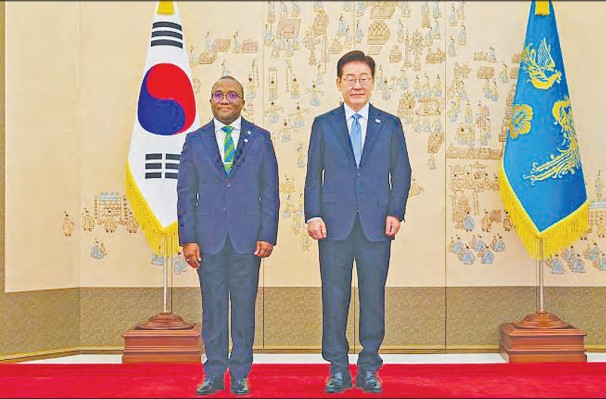

THE appointment of Tanzania’s Ambassador to the Republic of Korea marks a new phase in bilateral relations, with a renewed focus on expanding economic cooperation, attracting investment, increasing trade and strengthening socio-political ties between the two countries.
Presenting Letters of Credence to President Lee Jaemyung at Cheong Wa Dae (the Blue House) recently, the Ambassador formally began a diplomatic mission aimed at deepening the longstanding partnership between Tanzania and South Korea.
The assignment comes at a time when relations between the two nations are expanding beyond traditional development cooperation into a broader strategic partnership covering trade, investment, technology, infrastructure, education, tourism, culture and innovation.
Since Tanzania established its Embassy in Seoul in 2018, the relationship has continued to gain momentum. As the third resident Tanzanian Ambassador to South Korea, the mission is focused on advancing practical cooperation that delivers economic benefits for both countries.
For more than three decades, Tanzania and South Korea have built relations founded on mutual respect and shared development objectives. What began primarily as development cooperation has gradually evolved into a wider partnership driven by economic opportunities, technological advancement and private-sector engagement.
A key pillar of this cooperation has been South Korea’s development support through institutions such as the Korea International Cooperation Agency (KOICA) and the Economic Development Cooperation Fund (EDCF). From 1987 to 2024, South Korea provided Tanzania with approximately 875 million US dollars in official development assistance.
In addition, the latest EDCF Framework Arrangement covering 2024 to 2028 provides up to 2.5 billion US dollars in concessional financing for strategic infrastructure and development projects. Beyond development financing, Korean companies are increasingly showing interest in Tanzania’s infrastructure, mining, agriculture, manufacturing and tourism sectors.
ALSO READ: Understanding weather, its impact on people nature and the future
The growing commercial engagement reflects opportunities for a deeper partnership based on investment, trade and technology transfer. South Korea’s transformation from a war-torn country into a global economic powerhouse offers important lessons for Tanzania’s development ambitions. The country’s success, often described through the “Miracle on the Han River,” demonstrates the impact of strategic leadership, investment in education, innovation, technology and strong cooperation between government and the private sector.
Tanzania views South Korea’s experience as a valuable model in pursuing industrialisation and economic transformation. The country is particularly interested in lessons from Korea’s achievements in advanced manufacturing, digital innovation, artificial intelligence, semiconductor technology and green development.
Tanzania possesses many of the foundations required for accelerated growth. With a population of more than 63 million people, abundant natural resources, political stability, access to major regional markets and a clear development agenda under Tanzania Development Vision 2050, the country is positioned to become one of Africa’s leading economies.
The two countries share complementary strengths that create opportunities for expanded cooperation. Tanzania’s priorities in industrialisation, infrastructure development, value addition, digital transformation, climate resilience and private-sectorled growth align closely with South Korea’s expertise in technology, manufacturing, engineering and innovation.
As South Korea advances its Global Pivotal State vision and expands engagement with Africa, Tanzania represents an important partner in building a relationship based on mutual economic interests and shared opportunities.
The partnership is already entering a more dynamic phase. High-level exchanges have increased, institutional cooperation has expanded, business engagement is growing and collaboration in education, infrastructure, technology and innovation continues to develop.
Initiatives such as the Korea-Africa Summit, the Korea-Africa Foreign Ministers’ Meeting, KOICA programmes and EDCF financing are helping transform relations from traditional development cooperation into a comprehensive partnership focused on shared prosperity.
From friendship to economic partnership
The evolving Tanzania-South Korea relationship reflects a wider global shift toward partnerships built not only around assistance but also around investment, innovation and long-term economic cooperation.
Tanzania offers South Korea strategic advantages in today’s global economy. As one of Africa’s politically stable countries, Tanzania provides access to the Indian Ocean and serves as a gateway to the East African Community (EAC), Southern African Development Community (SADC) and the African Continental Free Trade Area (AfCFTA). Through these regional connections, Korean businesses can access a continental market of more than 1.4 billion people while benefiting from Tanzania’s strategic location and expanding economy.
Tanzania’s natural resources, improving infrastructure, growing consumer market and investor-friendly reforms strengthen its position as an attractive destination for Korean investment. Bilateral trade reached approximately 255 million US dollars in 2025, demonstrating continued commercial engagement.
However, both countries see significant potential to increase trade volumes, diversify exports and create stronger links between businesses. One of the most promising areas of future cooperation is critical minerals.
ALSO READ: Thrown away today, valuable tomorrow: Rethinking Tanzania’s waste economy
As global demand rises for electric vehicles, renewable energy technologies and advanced manufacturing, minerals such as graphite, nickel, lithium, cobalt and rare earth elements are becoming increasingly important. Tanzania has significant deposits of these strategic resources, while South Korea has advanced capabilities in battery manufacturing, semiconductors and industrial technology.
A partnership between the two countries could promote responsible mineral development, local value addition, technology transfer, skills development and sustainable resource management. Such cooperation would support Tanzania’s industrial transformation while contributing to secure global supply chains. Education, research and innovation also present major opportunities.
South Korea’s economic rise was strongly supported by investment in human capital and technological development, areas that remain central to Tanzania’s development goals. Through KOICA, South Korea has invested approximately 44 million US dollars in education and human capital development in Tanzania.
This includes support for Morogoro Polytechnic College, STEM education programmes, competency-based secondary education in Zanzibar and initiatives supporting out-of-school adolescents.
Expanding partnerships between universities, research institutions and innovation centres can strengthen skills development while creating lasting connections between Tanzanian and Korean communities. Going forward, Tanzania aims to attract more Korean foreign direct investment, advanced technologies, development financing and technical expertise to accelerate industrialisation.
The country also seeks to expand exports of value-added goods and services while creating opportunities for Tanzanian companies, entrepreneurs and skilled professionals to access the Korean market. People-to-people relations remain another important foundation of the partnership.
Education exchanges, tourism, academic cooperation, cultural programmes and language promotion can strengthen understanding between Tanzanians and Koreans. The global popularity of Korean culture demonstrates how cultural connections can build bridges between societies.
Similarly, Tanzania’s rich cultural heritage, Kiswahili language and traditions provide opportunities for meaningful exchange. Programmes promoting Kiswahili, youth engagement, academic cooperation and cultural initiatives such as the proposed 2027 Hanbok Expedition to Tanzania can further strengthen cultural diplomacy.
As Tanzania begins this new diplomatic chapter in Seoul, the focus is on transforming cooperation into measurable outcomes. The mission aims to promote greater Korean investment, expand trade opportunities, encourage technology transfer and strengthen development cooperation.
The Embassy will serve as a platform connecting governments, businesses, universities, researchers, entrepreneurs and cultural institutions to create practical partnerships. Ultimately, the future of Tanzania-Korea relations will depend not only on government agreements but also on the involvement of businesses, innovators, students and communities.
Through shared ambition, strategic cooperation and stronger people-to-people links, Tanzania and South Korea are positioned to build a partnership that supports economic transformation, regional development and long-term prosperity for both nations. The writer is Tanzania’s Ambassador to the Republic of Korea