
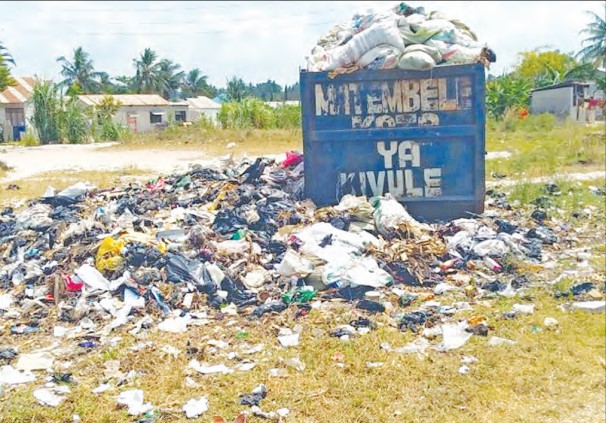

DAR ES SALAAM: EVERY day, millions of Tanzanians throw away food scraps, plastic bottles, paper, cans and other household waste without giving it a second thought. Collectively, the country produces more than 12 million tonnes of waste every year. Yet less than half of this waste is collected, meaning much of it ends up in streets, rivers, open spaces or is burned in the open.
Even where waste is collected, most is not converted into value: assessments suggest under a fifth of it is sorted or processed into a usable resource, a processing gap as much as a collection one. The consequences are visible in many of our communities.
Blocked drainage channels contribute to flooding during the rainy season. Plastic waste pollutes rivers and the ocean. Open dumping and burning contaminate the air we breathe, while decomposing waste releases methane, a greenhouse gas that contributes to climate change.
But hidden beneath this growing environmental challenge lies an equally significant economic opportunity. What if the waste we throw away every day could help protect our environment while creating decent jobs and sustainable incomes for women and young people?
As Tanzania searches for practical ways to strengthen climate resilience, reduce unemployment and build a greener economy, this question deserves serious attention.
The answer may lie in embracing the circular economy, an approach that keeps materials in use for as long as possible instead of treating them as disposable. The concept is simple. Rather than following the traditional pattern of taking, using and throwing away resources, a circular economy encourages reuse, recycling and recovery.
Organic waste becomes compost or clean cooking fuel. Plastic is transformed into new products. Scrap metal is reused. Paper finds a second life. Waste, in other words, becomes a valuable resource instead of an environmental burden. For Tanzania, this is more than an environmental conversation. It is an economic one.
Around three-quarters of the country’s municipal waste comes from households, and much of it is biodegradable, including food leftovers and garden waste. Yet only a small portion is recycled.
Every day, materials with real economic value are discarded because they are mixed together, poorly managed or simply overlooked. At a time when youth unemployment remains a major concern and many women continue to face barriers to earning a reliable income, this represents a missed opportunity.
ALSO READ: Oryx donates 600 LPG cylinders to Bagamoyo entrepreneurs
The scale of that opportunity is significant. Youth make up more than 64% of Tanzania’s workforce, and government officials have increasingly begun describing waste recycling and clean energy as a jobs strategy, not only an environmental duty. The circular economy offers something different.
It creates businesses that improve the environment while generating livelihoods. Waste collection, sorting, recycling, composting and manufacturing recycled products all have the potential to create jobs that are both environmentally sustainable and economically inclusive. So far, most of this activity in Tanzania sits at the collection and recycling end of the chain.
Moving into energy conversion, such as anaerobic digestion or pyrolysis, remains rare, held back less by feedstock than by thin financing and weak incentives. The most convincing evidence, however, is not found in policy papers. It is found in communities. One such example can be found in Kigilagila, Ilala, Dar es Salaam, where a community environmental group called Kigilagila Rafiki Mazingira (KIRAMA) is demonstrating that waste can become both a climate solution and a source of income.
Led by Erpidius Nyerere, the group collects household waste from homes, restaurants, hotels and offices before sorting it carefully. Suitable organic materials are then heated under controlled conditions to produce biochar, mixed with natural binding materials, compressed into charcoal briquettes using simple machines, dried and packaged for sale.
The finished briquettes provide a cleaner and more affordable cooking fuel while helping reduce dependence on traditional charcoal, easing pressure on Tanzania’s forests. Yet the group’s greatest achievement is not simply the briquettes. It is the lives they have transformed.
Not long ago, Neema Justus had no reliable source of income. Like many young women, she struggled to find employment and worried about how she would support herself. Everything changed when she joined Kigilagila Rafiki Mazingira.
Through collecting, sorting and recycling waste, Neema found much more than a job. She found dignity, confidence and financial independence. The income she earns has given her stability and renewed hope for the future.
Her story is far from unique. There is also Martha George, who once depended almost entirely on her husband’s income to support their family. Today, the money she earns through recycling helps pay school fees, contributes to household expenses and allows her to participate equally in providing for her family. What began as waste management has become a pathway to economic empowerment.
Watching women like Neema and Martha transform their lives offers an important lesson. Climate action is not only about reducing emissions or protecting ecosystems. It is also about creating opportunities for people. When environmental solutions improve household incomes, communities become active partners in conservation. Protecting nature is no longer seen as a sacrifice.
It becomes an investment in a better future. This integrated approach is increasingly recognised by organisations such as Resilience Aid, a Tanzanian non-governmental organisation committed to building climate-resilient and healthy communities.
Through programmes focused on climateresilient water, sanitation and health systems, green livelihoods and the circular economy, and ecosystem restoration, the organisation demonstrates that environmental protection and economic development are not competing priorities.
ALSO READ: GCLA tightens chemical safety oversight
They reinforce one another. A closer look at who benefits, however, shows an important caution. Women already form the backbone of Tanzania’s informal waste economy, yet remain concentrated in its lowest-paid sorting and collection tier, a gap that training alone will not close.
Still, isolated success stories alone will not unlock Tanzania’s green economy. Significant barriers remain. Most households do not separate waste before disposal, making recycling more difficult and expensive. Informal waste collectors often work without adequate equipment, recognition or social protection, despite providing an essential environmental service. Local authorities continue to face challenges related to inadequate infrastructure, high collection costs and limited public awareness.
These are not reasons to lower our ambitions. They are reasons to strengthen our commitment. The government can create stronger incentives for waste separation and recycling businesses. Local authorities can invest in more efficient collection systems and support community enterprises. The private sector can expand markets for recycled products and green technologies.
Financial institutions can develop affordable financing for green entrepreneurs, while development partners can continue supporting innovation that links climate action with income generation.
Encouragingly, a small but growing set of financing mechanisms is beginning to target this gap, including the gender-focused Jasiri Gender Bond and partners such as UNIDO, SIDO and the African Development Bank’s Green Growth Investment Program. Above all, we need a shift in mindset.
For too long, waste management has been viewed primarily as a sanitation issue. It should also be recognised as an economic opportunity, a climate solution and a driver of inclusive development. The women of Kigilagila Rafiki Mazingira are not waiting for someone else to solve climate change. Every day, they are collecting discarded materials, producing cleaner cooking fuel, protecting forests, reducing pollution and earning an honest living.
Their work reminds us that resilience is not always built through billion-shilling projects or sophisticated technologies. Sometimes it begins in a neighbourhood, with a determined community willing to look at a pile of waste and see possibility instead of rubbish. A pattern echoed regionally, from Kampala to Dar es Salaam, where waste is increasingly seen as a source of green jobs.
As Tanzania works towards a greener and more climate-resilient future, perhaps the most important transformation is not in the waste itself. It is in the way we choose to see it. Because when we begin to see waste as wealth, we do more than clean our environment, we create livelihoods, empower women and young people, strengthen our communities and invest in a more sustainable future for generations to come.
The author is a Communications Specialist, reachable via mgayaadrian@ gmail.com