
DAR ES SALAAM: THERE are wounds that cannot be seen by the eyes. Wounds that do not bleed, yet silently drain a person’s inner peace for years without anyone noticing.
For many people in Tanzania, remembering painful or traumatic events is often treated as a normal part of life.
People are told to “just forget and move on.” But for mental health professionals, those memories are not always ordinary, they can be signs of a condition known as Post-Traumatic Stress Disorder (PTSD).
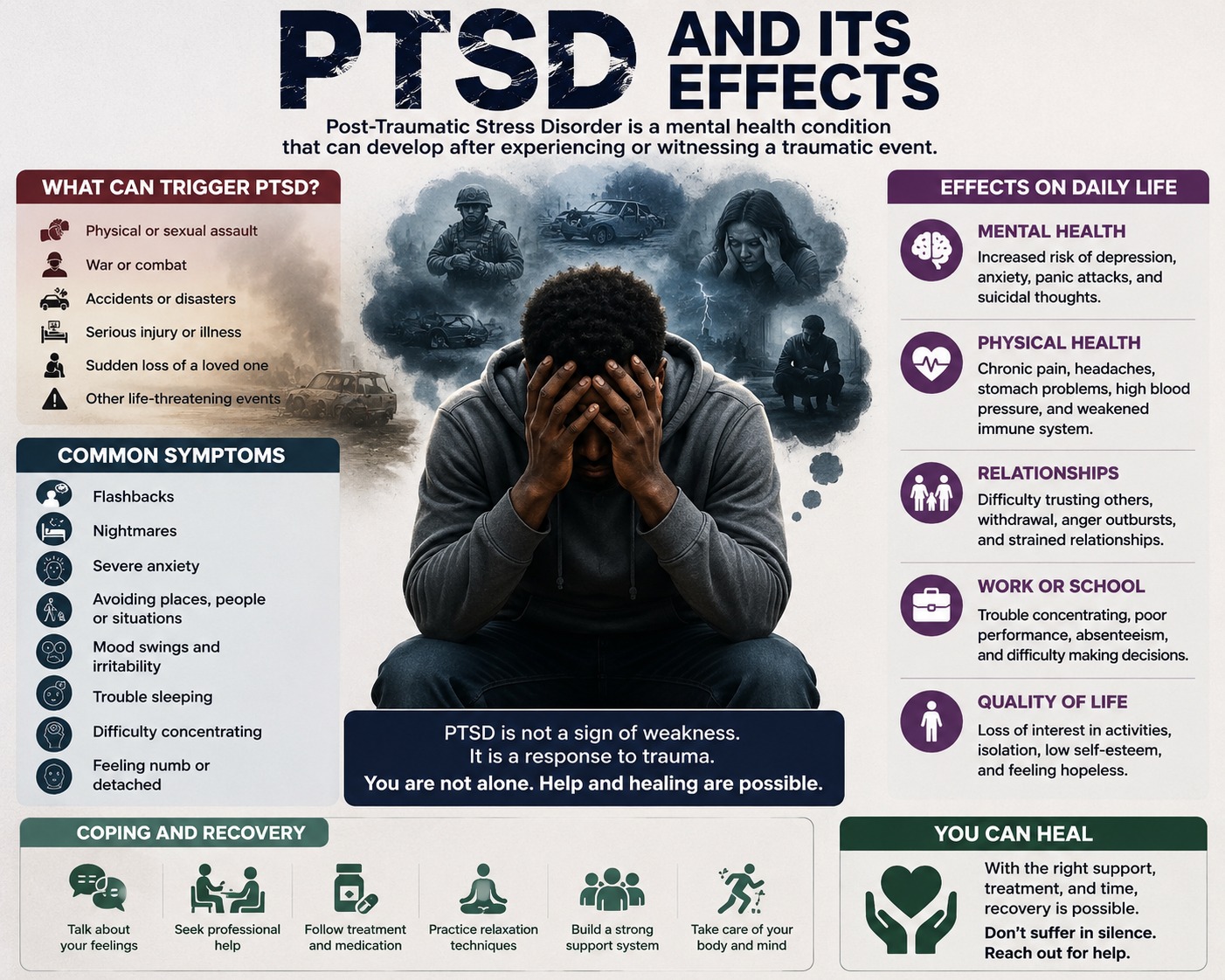
PTSD is a mental health condition that can develop after a person experiences or witnesses a terrifying event, one that threatens life or causes severe emotional distress.
It does not choose its victims; it can affect a child, a young adult, or an older person regardless of their background.
Speaking about surviving an electric shock incident, Razack Juma, a resident of Temeke, Dar es Salaam, said that he is still deeply traumatised and now fears seeing any exposed wires on the road, whether electricity or TTCL cables.
He said the experience has left him with lasting fear, to the extent that he avoids any route where he sees wires lying on the ground.
“I still have a lot of fear inside me and I don’t know when it will go away. Sometimes even when I see any wire lying on the road, I avoid that path because I still remember what happened to me,” said Mr Juma.
The Chairperson of the Standing Committee on Professional Affairs of the Tanzania Psychological Association (TAPA), Jesusa Malewo, explains that PTSD is often misunderstood as something that only affects people in war zones or disaster-prone regions.
However, many people in Tanzania are living with it without realising it.
Road accidents, fire disasters, gender-based violence, domestic abuse, floods, and sudden loss of loved ones are among the key events that leave deep psychological scars.
“Sometimes the event is over, but the mind never finishes processing it. Fear, memories and emotional pain continue to live inside the person,” Mr Malewo explains.
Unlike normal stress, which usually fades with time, PTSD persists and interferes with daily life, at work, in school, and even in relationships.
Mr Malewo explains that symptoms are grouped into four main categories. The first is intrusion, where a person experience repeated and unwanted memories of the traumatic event.
These may come in the form of nightmares or flashbacks that make the person feel as though the event is happening again.
The second category is avoidance, where a person tries to stay away from places, people, or conversations that remind them of the trauma.
Mr Juma said he no longer wants to walk during rainfall or thunderstorms, as he still feels the pain and fears he may not be able to forget the experience.
He added that he is now considering moving from his current neighbourhood because seeing the place where he nearly lost his life due to an electric shock continues to trigger strong memories and fear.
The third category involves negative changes in thoughts and emotions. A person may withdraw from others, lose interest in activities they once enjoyed, feel hopeless, or experience intense guilt and self-blame.
The fourth category is hyperarousal, where the person becomes easily startled, irritable, struggles with sleep, and finds it difficult to concentrate or make decisions.
He said, “after a traumatic event, it is normal for a person to feel afraid for a short time. But when these symptoms last for more than a month or begin to interfere with daily life, professional help is necessary.”
However, PTSD goes beyond symptoms. It deeply affects three fundamental areas of human life: the sense of connection, safety, and stability.
In terms of connection, a person may struggle to trust others or form close relationships. This often begins in childhood when the brain protects itself by emotionally disconnecting to survive overwhelming pain.
As a result, even in adulthood, a person may find it difficult to trust or maintain intimate relationships.
Regarding stability, individuals who grew up in environments of deprivation or neglect may continue living in fear of loss even when their situation has improved. They may overprotect resources or behave as though scarcity still exists.
In terms of safety, PTSD makes a person feel constantly unsafe, even when there is no real danger.
“A person with PTSD often feels like they are still in danger, even when everything around them is safe,” Mr Malewo explains.
Not everyone who experiences trauma develops PTSD. People differ biologically, genetically, and through their upbringing and life experiences. These differences shape how individuals respond to stressful events.
He added, “some people have stronger coping mechanisms than others. This is why two people can go through the same experience but end up with completely different outcomes.”
However, those affected by PTSD are at higher risk of developing other mental health conditions such as depression, anxiety, substance abuse, and even suicidal thoughts.
One of the biggest challenges is silence caused by stigma. Many people avoid seeking help because they fear being judged or labelled as weak.
“Stigma delays people from getting help,” says Malewo. “Yet PTSD is a medical condition just like any other.”
For individuals who have experienced trauma, the first steps before professional help are crucial. What is needed most is not immediate solutions, but the presence of someone who listens without judgment.
“Most people do not need solutions right away; they need to be heard,” she emphasises.
Listening, allowing someone to express their emotions freely, and reassuring them of safety are key steps that can reduce the intensity of emotional pain in the early stages.
It is also important to encourage the person to seek professional mental health support, along with support from family and friends.
In Tanzania, the rise in road accidents, violence and sudden disasters has increased the need for stronger mental health services.
Experts recommend increasing the number of mental health professionals, launching public awareness campaigns on PTSD and strengthening counselling and psychosocial support services.
“Mental health services should not wait for disasters to happen. They must be part of disaster preparedness systems,” says Mr Malewo.
Regarding Tanzania’s situation in addressing mental health challenges due to the rising number of road accidents, gender-based violence, and sudden deaths, she said the country needs to further strengthen mental health services at all levels.
He recommended increasing the number of mental health professionals, launching public awareness campaigns about PTSD, and improving counselling and psychosocial support services, especially for survivors of disasters and violence.
Mr Malewo also emphasised the importance of establishing dedicated mental health units within disaster management systems to ensure immediate support is available during emergencies.
“Mental health services should be part of disaster preparedness plans, not something that is arranged only after a disaster has already occurred,” she stressed.
PTSD can affect anyone, but it is also treatable. With early support from family, community, and mental health professionals, recovery is possible, and people can return to normal life, slowly, but with renewed hope.
And sometimes, healing begins the moment someone is finally listened to without judgment.