

DAR ES SALAAM: THE 2026/27 national budget has revived an ongoing debate in public finance: whether rising debt is used for productive investments expected to boost future economic growth or mainly to cover recurrent costs and fiscal commitments.
Equally crucial is the discussion of understanding the remaining fiscal space for Tanzania to address future shocks, fund development projects, and maintain sustainable debt levels.
An analysis of the 2026/27 budget suggests that Tanzania continues to pursue a strategy in which debt financing is largely directed toward infrastructure, strategic development projects, and economic transformation initiatives.
However, increasing debt-servicing obligations and a broader public expenditure envelope suggest that the country’s fiscal space is becoming more self-sustaining, with greater reliance on domestic sources than a decade ago.
It also continues to improve its resource mobilisation efforts to support its development agenda, rather than relying heavily on external support. Amid this achievement, to be on the same page, let us understand productive debt financing.
To those who aren’t conversant with the economics behind these issues, public debt becomes economically beneficial when borrowed funds are invested in projects that generate future economic returns.
Such returns may arise from increased tax revenues, export earnings, job creation, improved productivity, reduced business costs, or enhanced economic competitiveness.
Examples encompass transport infrastructure, energy generation and transmission, grid water supply systems, industrial parks, business hubs, agricultural irrigation schemes, ports and logistics facilities, and digital infrastructure.
In contrast, debt is less effective when it mainly funds recurring expenses like wages, administrative costs, or subsidies, which do not produce long-term economic benefits.
With this brief in mind, as many of us continue to digest the presented budget, the discussion could then be about whether the 2026/27 budget continues to channel borrowed resources into growth enhancing investments.
From an economic perspective, one of the strongest indications that Tanzania’s debt financing remains investment-oriented is the continued emphasis on development expenditure in the FY2026-2027 budget.
According to the budget presented in the House, the government has allocated significant funds to transport infrastructure.
Key investments are ongoing in the completion of the remaining portions of the Standard Gauge Railway (SGR), road construction and rehabilitation, rural connectivity projects, port modernization, and airport expansion.
Strategically, these projects are designed to lower transportation costs, improve regional trade competitiveness, and strengthen Tanzania’s position as a logistics hub serving East and Central Africa.
The economic benefits of transport investments usually appear as shorter travel times, decreased freight expenses, expanded trade volumes, and increased private sector investment.
As far as energy sector investments are concerned, the proposed budget continues to support strategic energy projects, including electricity generation, transmission networks, rural electrification, and renewable energy initiatives.
Reliable and affordable energy remains an essential driver of industrial growth. As our parliamentarians begin to digest and contribute to the MoF’s proposed budget speech for FY2026/27, they need to recognise that investing in energy infrastructure through debt financing can boost productivity across almost all sectors of the economy.
Moreover, the government’s continued focus on water supply and irrigation programmes shows a recognition that climate resilience and agricultural productivity are essential for long-term economic growth.
These investments can boost crop yields, decrease drought risks, promote agro-industrial development, and notably enhance public health. But for all this to achieve the intended objective effectively and in a timely manner, human capital investments also matter.
The FY2026-2027 budget tabled by Finance Minister Ambassador Khamis Mussa Omara underscores that, although infrastructure receives considerable attention, productive investment is not limited to physical assets alone.
The budget, upon careful review, covers education, healthcare, and skills development. Investing in human capital boosts labor productivity and can lead to substantial economic benefits in the long run.
For instance, improved education enhances workforce competitiveness; better healthcare increases productivity and decreases economic costs from illness; and technical or vocational training aids industrialization initiatives.
Therefore, Tanzania’s borrowing, small as it may be, as suggested in the budget speech, will contribute in part to future growth by investing in human capital development.
Across all these points, a crucial aspect is that debt sustainability is still a primary concern. The main issue isn’t just if Tanzania is borrowing, but whether that borrowing is sustainable.
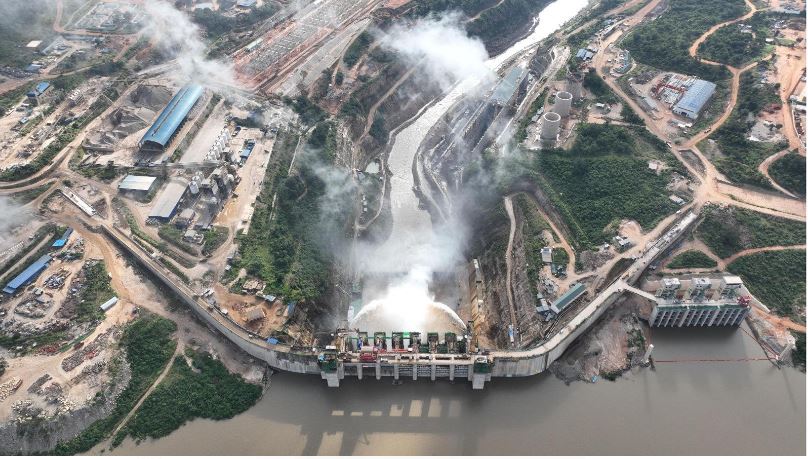
ALSO READ: Julius Nyerere hydropower project is 99.8% complete
Experts in public debt management will agree that a country can borrow safely when economic growth outpaces borrowing costs, debt funds productive investments, government revenues keep increasing, and debt repayments stay manageable.
Taking into account the FY2026-2027 budget, recent assessments by Moody’s, and World Bank review reports, Tanzania’s economy has consistently maintained robust growth compared to many other developing countries.
Growth in sectors such as mining, construction, tourism, agriculture, telecommunications, and financial services continues to support debt sustainability by increasing future tax revenues.
Nevertheless, the country’s debt sustainability increasingly relies on the successful completion and functioning of key infrastructure projects.
Among the good proposals in the FY2026-2027 budget, debt servicing is an area that requires close attention. As public debt rises, a larger share of government revenues will need to be allocated to interest payments and principal repayments.
This reduces the funds available for new investments, social services, and emergency responses. Even if the debt remains manageable, rising debt-service costs gradually reduce fiscal flexibility.
Essentially, each shilling spent on debt payments is a shilling that cannot be used for new development priorities. A key feature of the 2026/27 budget is its emphasis on boosting domestic revenue.
Enhancing revenue collection boosts internal fiscal strength. Instead of just raising tax rates, the government, as outlined in the FY2026- 2027 budget, is committed to implementing tax administration reforms such as digital tax systems, widening the tax base, improving compliance, and crucially, reducing tax leakages.
This strategy will help generate additional revenue without overburdening taxpayers.
Essentially, expanding domestic revenue increases fiscal space by reducing dependence on borrowing, which supports debt repayment and funds development projects through local means. The more comprehensive and efficient the tax system, the greater Tanzania’s fiscal flexibility.
Those reviewing the budget speech may then ask, “How much fiscal space remains in accordance with the FY2026-2027 budget proposal?”
For non-economists and those unfamiliar, it is necessary to understand that fiscal space refers to the government’s ability to increase spending or respond to economic shocks without jeopardising fiscal sustainability.
Several factors in the proposed FY2026-2027 budget indicate that Tanzania still retains meaningful fiscal space. Regarding economic growth prospects, the country’s medium-term outlook stays quite positive.
This growth enhances fiscal space by broadening the tax base, boosting government revenues, and improving debtto-GDP ratios. A growing economy can sustain higher levels of debt than a stagnant economy.
Secondly, ongoing access to concessional financing offers numerous advantages. Tanzania still maintains access to multilateral financing, bilateral development aid, and concessional loans.
These loans feature lower interest rates and longer repayment periods, reducing debt-servicing pressures. This access grants greater fiscal flexibility compared to countries that rely heavily on costly commercial loans.
Thirdly, concerning moderate debt indicators, although public debt has increased significantly over the past decade, most debt metrics remain within internationally accepted sustainability limits.
This indicates that the government can still borrow for high-priority projects, although its borrowing capacity is now more constrained. Similarly, when considering foreign exchange risks, a key limitation on future fiscal capacity is external debt.
Many infrastructure initiatives rely on foreign-currency loans. If the Tanzanian shilling depreciates sharply or global interest rates climb, the costs of servicing debt could rise considerably. This would reduce available fiscal space.
Thus, what are the areas that could constrain future fiscal space emerging from the proposed budget? Clearly, as an analyst, one critical point is that, despite current strengths, several risks could narrow Tanzania’s fiscal room over the coming years.
As recurrent expenditure increases, expanding infrastructure results in higher operating and maintenance costs.
New roads, railways, ports, schools, and hospitals need ongoing expenses like maintenance, staffing, utilities, and repairs, while IT solutions require updates. Over time, these recurrent costs can drain resources that might otherwise support new investments.
Likewise, climate-related expenditures are expected to rise. Future spending may be needed for flood protection, drought mitigation, disaster response, and climate adaptation infrastructure. Such obligations could place additional pressure on public finances.
Since Tanzania is part of the global economy and not an island, it will remain vulnerable to global economic uncertainties and external shocks.
Major global factors beyond Tanzania’s influence include rising oil prices, geopolitical tensions, commodity price fluctuations, and tighter global financial conditions.
Such shocks, in my view, can simultaneously reduce revenues and increase expenditure needs. Hence, beaming through the proposed FY2026-2027 budget, one could then ask Is debt financing truly supporting productive investment?”
As an analyst who has listened to and reviewed both versions, English (166 pages) and Kiswahili (192 pages), of the proposed budget by Hon. Ambassador Khamis Mussa Omara, I can confidently say that the 2026/27 budget indicates a significant portion of Tanzania’s debt financing is directed toward productive investments rather than just consumption.
The government’s investment priorities continue to focus on sectors that can deliver long-term economic benefits, including transport, energy, water, agriculture, education, health, and industrial development.
These investments align with the goals of economic transformation and Vision 2050. The effectiveness of the proposed FY2026-2027 budget depends heavily on effective implementation.
Debt financed projects generate returns only when they are completed on time, cost overruns are controlled, assets are properly maintained, and economic benefits are realised. It’s crucial to recognise that poor project management can turn profitable debt into a financial strain.
Considering Tanzania’s ability to borrow more as many Tanzanians continue to seek more fiscal space in the 2026-2027 proposed budget, I believe the answer is a strong yes.
The 2026/27 budget emphasises a development focused fiscal approach, with public borrowing primarily to be directed toward infrastructure, human capital, and economic investments.
This indicates that Tanzania’s debt financing continues to support future growth rather than just funding current expenses. At the same time, fiscal space is becoming more valuable and requires careful management.
Although Tanzania still has some room to fund strategic priorities through domestic revenue, concessional loans, and economic growth, increasing debt service costs, climate challenges, and global economic uncertainties could limit fiscal flexibility compared to previous years.
Tanzania’s main challenge now is not just the amount it might borrow but how well it transforms borrowed funds into productive assets that produce economic benefits.
If the projects funded by the 2026/27 budget meet their goals for growth, employment, and revenue, Tanzania’s debt will be viewed more as an investment in future prosperity than a burden on future generations.