
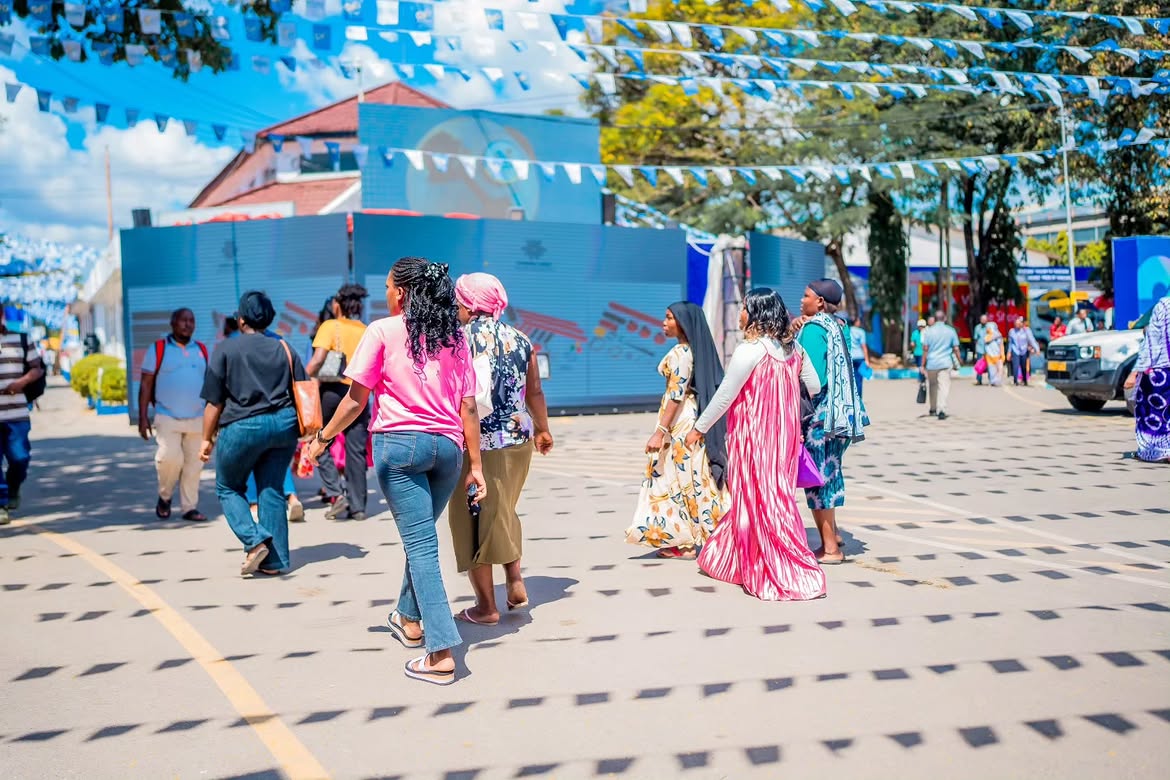
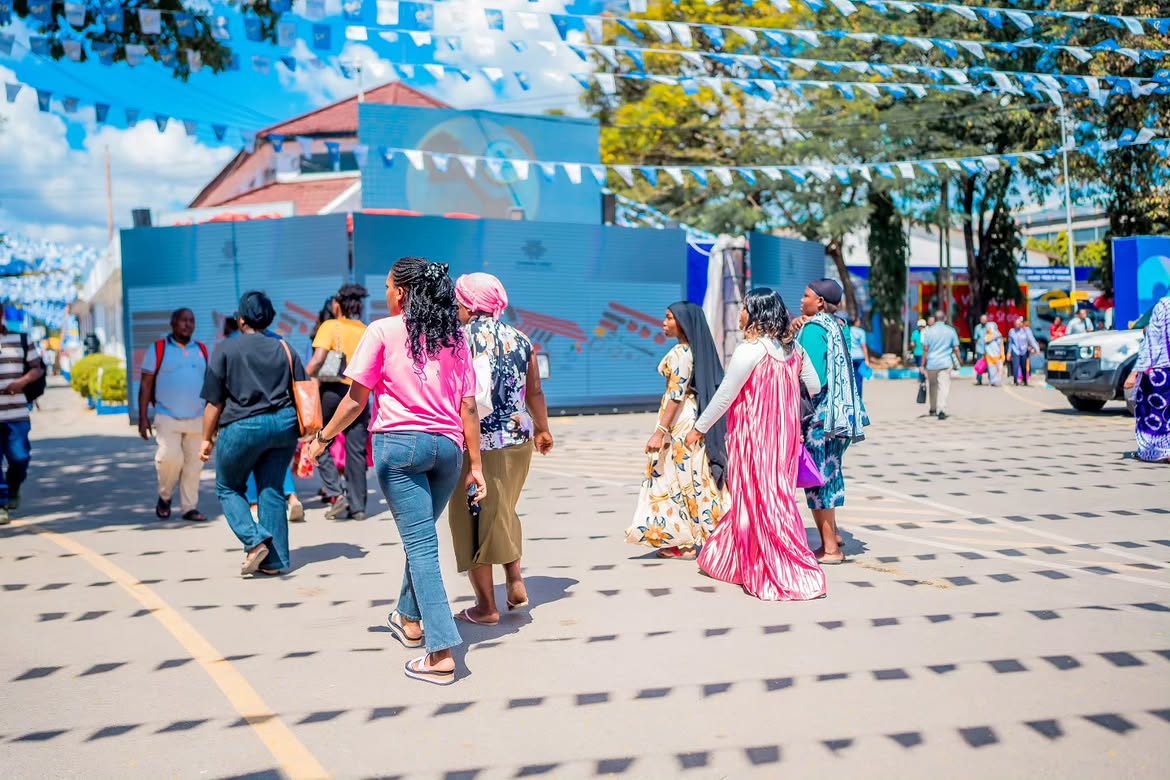
DAR ES SALAAM: SABA SABA is meant to be a day of national memory, commerce and shared public life. The seventh day of the seventh month marks the 1954 founding of TANU, a movement that helped unite Tanganyika in the struggle for independence.
In modern Tanzania, it is also inseparable from the Dar es Salaam International Trade Fair, where families visit, businesses exhibit, young people explore opportunities and traders meet customers. This year marks 72 years since TANU’s founding, but the atmosphere around 7 July 2026 is not only one of celebration.
It has been overshadowed by planned demonstrations, security deployments, online threats, political arguments and a growing uncertainty over whether ordinary citizens should go about their normal holiday activities at all. That uncertainty matters because Saba Saba is not a small event.
TanTrade’s 2026 platform for the 50th Dar es Salaam International Trade Fair lists more than 550,000 visitors, 3,500 exhibitors and 7,200 products. Behind these figures are families, schoolchildren, traders, transport operators, food vendors, exhibitors and workers. For many parents, the question is no longer simply whether to take children to the grounds for shopping and recreation.
It has become whether the country will be calm enough for a normal family outing. This is an unfortunate position for Tanzania to reach. Parents should not have to interpret viral videos, anonymous threats, political slogans or frightening WhatsApp messages before deciding whether children can attend a national trade fair.
Nor should a decision to remain at home be treated as political support for one side, just as attending the fair should not be mistaken for a political statement. It is a normal parental instinct to choose caution when the public environment is unclear.
The concern is not imaginary. Planned youth-led demonstrations have been linked to demands for democratic reform and accountability following the violence around the October 29th 2025 election. The government has responded by banning political rallies and strengthening security in Dar es Salaam and other cities, citing threats. The October 29th experience gives the government a genuine reason to prepare.
A government-appointed inquiry later reported at least 518 deaths, more than 800 gunshot injuries and 245 people unaccounted for after the election violence. These figures do not prove that every future protest will become violent, nor do they establish responsibility for every death and injury.
ALSO READ: Japan’s 269m/- boost transforms Babati school
They do, however, demonstrate the terrible cost when political tension, crowd disorder, criminal opportunism, fear and force collide. The Constitution of the United Republic of Tanzania provides an important balance. Article 18 protects freedom of opinion and expression.
Article 19 protects freedom of conscience and religion. Article 20 protects the freedom to assemble peacefully and express views publicly. Article 13 protects equality before the law and prohibits discrimination, including on grounds of religion.
At the same time, Article 30 makes clear that rights must not be exercised in a way that harms the rights of others or the public interest and it allows lawful measures aimed at public safety, public peace and the national interest. Tanzania’s constitutional position is therefore neither silence nor violence.
Citizens have a right to be heard; nobody has a right to endanger fellow citizens, damage property, intimidate communities or turn political disagreement into communal hostility. The current environment is made worse by claims that foreign actors, international institutions or overseas political groups are trying to influence Tanzania through sanctions. Here, public discussion needs accuracy.
It is true that the United States imposed a targeted sanction and travel ban on Tanzania’s police chief in May 2026 over alleged human-rights violations. It is also true that the European Parliament called on EU institutions to consider targeted sanctions against individuals found responsible for abuses and to reassess direct support to Tanzanian authorities.
These are serious external actions and they can understandably be viewed by many Tanzanians as pressure on national sovereignty. But they are not the same as Tanzania being placed under comprehensive international sanctions, nor do they mean that foreign actors should decide Tanzania’s political future.
There is a legitimate difference between international scrutiny, human-rights advocacy and foreign interference. Tanzania is part of regional and international systems that allow other states, parliaments and human-rights bodies to comment on events of public concern.
However, Tanzanians who call casually for broad economic sanctions against their own country should also consider the likely cost. Literature on sanctions shows that broad measures can reduce investment, weaken public services, burden ordinary citizens and sometimes allow governments to mobilise “defence of sovereignty” narratives that strengthen, rather than weaken, political control.
Research also warns that sanctions can damage civil society and middle- and lowerincome groups while leaving powerful actors better able to absorb the shock. Targeted accountability measures against specific individuals may be less indiscriminate than country-wide punishment, but even these measures are politically complex and do not automatically produce reform.
For this reason, Tanzania’s problems should not be outsourced. It is unhealthy for citizens to seek national economic pain as a shortcut to political victory, just as it is unhealthy for authorities to dismiss every criticism as foreign-sponsored interference.
The country needs credible domestic accountability, lawful investigation, courts that can be trusted, responsible media, parliamentary engagement, dialogue and constitutional reform where necessary.
A country does not protect its sovereignty by refusing to examine its own wounds; it protects sovereignty by resolving its problems through institutions that citizens can respect. Even more dangerous is the emergence of informal groups issuing threats and warnings from both sides of the political divide. Some present themselves as defenders of order; others speak as defenders of protest or resistance.
Once citizens begin to organise around intimidation, revenge or the policing of political loyalty, a national dispute becomes a contest of competing threats. The literature on political violence is clear that hostile online engagement between opposing protest groups is associated with a greater risk of physical violence in offline encounters.
This does not mean every angry online message will lead to violence, but it means threats should never be treated as harmless entertainment. The most dangerous development would be any attempt to turn a political disagreement into a Christian-versus-Muslim contest.
The credible reporting reviewed on the planned demonstrations describes political demands, not a verified, coordinated religious mobilisation. Claims that Christians and Muslims must take opposing sides should, therefore, be rejected as an unverified and inflammatory narrative.
Tanzania’s Constitution protects freedom of religion and equality before the law precisely because national citizenship must be greater than religious identity. A protester can be Muslim, Christian or of another faith. A police officer can be Muslim, Christian or of another faith.
A trader at Saba Saba can be Muslim, Christian or of another faith. Their safety and dignity cannot depend on which political slogan is circulating online. Tanzanian scholarship has long warned that political frustration can be channelled into religious identity if leaders and communities allow it.
ALSO READ: Planning reforms pave the way to a trillion-dollar economy
Heilman and Kaiser’s study of religion and politics in Tanzania noted the country’s strong traditions of cross-cutting identities and tolerance, while also warning that economic and political frustrations could be redirected toward religious extremist mobilisation.
Their survey evidence from that period found that 78 per cent of respondents viewed MuslimChristian relations positively and 86 per cent viewed the relationship between religion and the State positively. Those figures are historical, not a measure of public opinion in 2026, but they underline what Tanzania has to lose: a long tradition in which faith communities have lived, traded, studied and raised families alongside one another.
Other countries show why these matters. In Plateau State, Nigeria, local insecurity and political competition gradually became entangled with Christian-Muslim identity. Research on the area shows that vigilante groups, initially formed around local security concerns, became polarised along religious lines as violence intensified.
The 2001 riots in Jos killed more than 1,000 people. Tanzania is not Nigeria and no comparison should be used to predict that Tanzania will follow the same path. But the lesson is serious: when political conflict is recast as a struggle between religious communities, the original grievances become harder to solve and ordinary citizens become easier to target.
This is why religious leaders, political leaders, youth influencers, journalists and ordinary citizens carry a responsibility greater than winning an argument online. Christians and Muslims should reject calls to become political camps.
Political actors should stop using religious language to question another side’s loyalty to the nation. Social-media users should not circulate anonymous warnings, edited clips, old violence footage or messages that portray fellow Tanzanians as enemies.
A person who shares a threat may think they are defending their side, yet they may be contributing to the climate that makes violence more likely. For parents deciding whether to attend the SabaSaba grounds, the responsible approach is precaution without panic.
No one can guarantee safety in advance when official advisories, transport access and crowd conditions may change quickly. Families should rely on official information from TanTrade, police and local authorities rather than anonymous online claims.
Where credible warnings, road restrictions or abnormal crowd conditions persist, postponing non-essential shopping or taking young children into a tense environment is a reasonable safety decision, not a political position. The same principle should apply to organisers and authorities alike: children, families, traders and uninvolved citizens must never become collateral damage in a political confrontation.
Saba Saba should remind Tanzania of how national unity was built, not become a date associated with fear, threats and religious suspicion. The country can protect public order without criminalising every peaceful voice.
Citizens can demand accountability without inviting national economic harm. International actors can raise concerns without becoming substitutes for Tanzania’s own institutions. Most importantly, Tanzanians can disagree politically without being divided as Christians and Muslims.
The real national test on 7 July is not who shouts loudest, who threatens most convincingly or who claims ownership of patriotism. It is whether Tanzania can preserve the dignity of peaceful expression, protect the safety of ordinary families and refuse every attempt to turn political tension into religious division. That is the path most consistent with the Constitution, the economy, national sovereignty and the Tanzania that future generations deserve.