
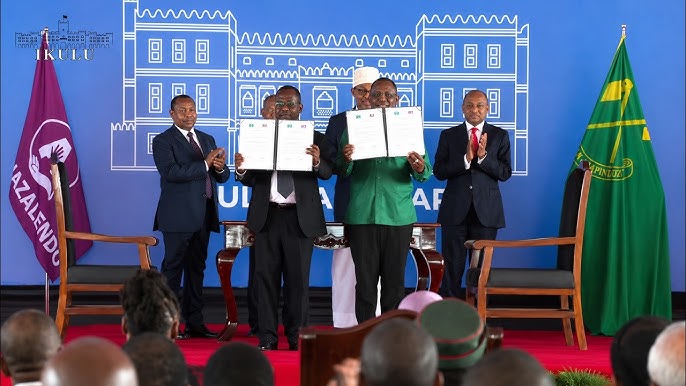
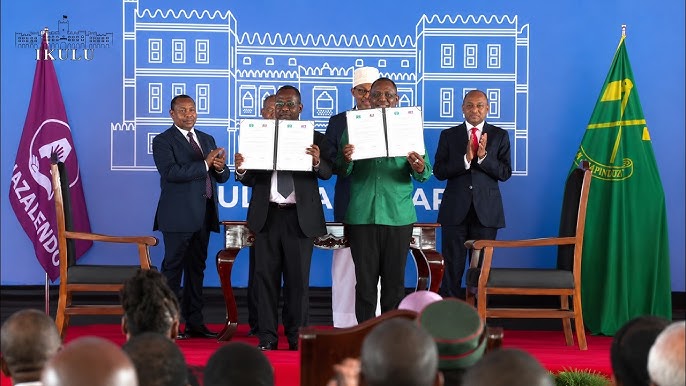
ZANZIBAR: THE political reconciliation agreement signed between Chama Cha Mapinduzi (CCM) and ACT Wazalendo in Zanzibar marks more than the end of a prolonged political impasse.
It represents a renewed commitment to dialogue, national unity and inclusive development, reinforcing the belief that lasting peace remains the strongest foundation for Zanzibar’s prosperity.
Speaking during what many described as another historic milestone in Tanzania’s political journey, President Samia Suluhu Hassan hailed the agreement between the two parties as a demonstration of political maturity, patriotism and responsible leadership, saying it places the interests of Zanzibar and the United Republic of Tanzania above partisan considerations.
President Samia said the accord sends a powerful message that political differences should never be allowed to degenerate into conflict or instability. Instead, she stressed, they should be resolved through dialogue and constructive engagement that advances the welfare of citizens, strengthens national unity and accelerates development.
“Political agreement is not a sign of weakness, but of maturity. It lays the foundation for unity and mutual respect,” President Samia said, adding that peace in Zanzibar contributes directly to peace and stability across Tanzania.
President Samia’s remarks reinforce the long-held national conviction that lasting peace, security and social cohesion are indispensable foundations for sustainable development, economic transformation and shared prosperity.
For decades, Zanzibar has built a reputation for peace, resilience and steady socioeconomic progress. Yet, as in many democracies, periods of political contestation have occasionally created tensions capable of disrupting economic activity, undermining investor confidence and slowing the pace of development. The latest agreement seeks to break that cycle by placing dialogue, consensus and national interest above political confrontation.
President Samia reaffirmed the government’s commitment to supporting every initiative that promotes peace, strengthens national unity and safeguards social stability. She emphasised that maintaining a secure environment remains essential to protecting the country’s development gains and creating conditions conducive to sustained economic growth.
The President also made it clear that acts of violence, destruction of property and any conduct intended to undermine peace have no place in a democratic society. Political competition, she stressed, should never be used to justify actions that threaten national security or compromise the wellbeing of citizens.
While acknowledging that differing political views are an inherent feature of democracy, President Samia said such differences should always be resolved through peaceful dialogue, mutual respect and adherence to the rule of law.
The President’s remarks underscore a fundamental development principle: That enduring peace, political stability and national cohesion create the certainty upon which investment, economic transformation and shared prosperity are built.
The President observed that lasting peace provides the certainty citizens need to invest, build businesses, educate their children and improve their livelihoods with confidence.
The significance of the agreement extends well beyond politics. It reinforces one of the most important prerequisites for sustainable development, peace and political stability. Economists have long argued that stable political environments attract investment, stimulate tourism, create jobs and support long-term economic growth.
For Zanzibar, where tourism, trade, fisheries and the blue economy are key drivers of growth, political stability is a strategic economic advantage. It gives investors the confidence to commit capital, enables businesses to plan for the future and strengthens the confidence of development partners.
By fostering dialogue and consensus, the accord is expected to enhance Zanzibar’s reputation as a peaceful, stable and attractive destination for investment.
Recognising the significance of the breakthrough, President Samia commended Zanzibar President Dr Hussein Ali Mwinyi, the leadership of CCM Zanzibar and ACT Wazalendo for demonstrating statesmanship by choosing dialogue over confrontation.
She also paid tribute to former Zanzibar Presidents Dr Amani Abeid Karume and Dr Ali Mohamed Shein for their wisdom and sustained contribution to the reconciliation process, describing their efforts as an important investment in the Isles’ enduring peace and stability.
Their collective contribution, she noted, illustrates that safeguarding national interests requires cooperation across generations of leadership.
President Hussein Ali Mwinyi described the accord as the beginning of a broader process of political engagement, saying it provides a framework for continued dialogue on issues affecting Zanzibar’s future.
He said the agreement paves the way for the formation of a Government of National Unity in line with the Constitution of Zanzibar, while opening space for wider consultations involving citizens, the private sector, development partners and other stakeholders.
He added that sustainable development depends on trust between leaders and citizens.
The remarks suggest the agreement is intended to extend beyond resolving immediate political differences. Instead, they frame the accord as a mechanism for sustaining dialogue, strengthening constitutional governance and broadening participation in Zanzibar’s development process.
By linking development to public trust, President Mwinyi highlighted confidence in public institutions as an important element in advancing the Isles’ long-term development agenda.
The Chairman of ACT Wazalendo, Othman Masoud Othman, also welcomed the initiative, describing dialogue as the appropriate mechanism for resolving political challenges.
He said meaningful discussions provide opportunities to address outstanding issues while protecting the broader interests of Zanzibar and the nation.
Othman’s stance reinforces the growing consensus that peaceful engagement offers more sustainable solutions than prolonged political confrontation.
The agreement also carries broader implications for national cohesion within the United Republic of Tanzania.
Throughout the country’s history, unity has remained one of the strongest pillars supporting political stability and economic progress.
That unity has enabled Tanzania to maintain peace while pursuing ambitious development programmes across infrastructure, education, healthcare, energy and industrialisation.
The commitment demonstrated by political leaders in Zanzibar therefore complements national efforts to preserve an environment conducive to implementing long-term development priorities, including Vision 2050.
The accord also reflects an important democratic principle that competing political parties can disagree on policy while remaining united in protecting national interests.
Such an approach strengthens public confidence in democratic institutions and encourages citizens to participate peacefully in political processes.
Religious leaders, civil society organisations and development partners have repeatedly emphasised the importance of dialogue in strengthening reconciliation and preventing unnecessary conflict.
The participation of government leaders, political parties, religious leaders, traditional leaders, diplomats and representatives of various institutions during the signing ceremony further demonstrated broad national support for peaceful political engagement.
For ordinary citizens, the agreement carries practical significance.
A peaceful political environment creates favourable conditions for tourism, trade, agriculture, fisheries, investment and job creation.
Businesses operate with greater certainty, investors gain confidence, public services continue without disruption and communities can focus on improving livelihoods rather than managing political tensions.
ALSO READ: ACT-Wazalendo sees its reconciliation with ruling CCM as a key to political stability in Zanzibar
The Zanzibar political accord, hence, serves as a key reminder that consensusbuilding, responsible leadership and mutual respect remain among the country’s greatest strengths.
The focus now shifts to implementation. Expectations are that the agreement will translate the spirit of political consensus into sustained dialogue, stronger public trust and lasting reconciliation, while preserving the peace and stability that underpin Zanzibar’s development and Tanzania’s broader national prosperity.