

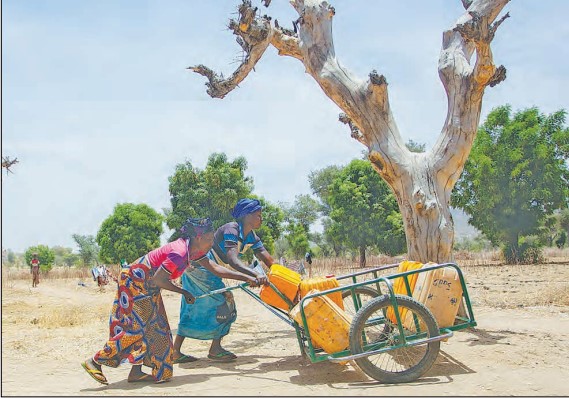
DODOMA: WHEN the rains fail in rural areas, it is often women who feel the impact first. They walk longer distances in search of water, spend more hours gathering firewood and shoulder the growing burden of feeding families when harvests decline.
And when floods, droughts or storms strike, many women receive life-saving warnings too late, or sometimes not at all. These realities are emerging sharply countrywide as climate change tightens its grip on everyday life, exposing not only environmental vulnerability but also deep gender inequalities that shape who suffers most during climate shocks.
A new 2025 Gender and Environment Survey released by the National Bureau of Statistics (NBS) shows that 82.9 per cent of women and 80.8 per cent of men on the Mainland Tanzania have already experienced at least one impact of climate change.
While both genders are affected, the burden falls disproportionately on women because of social responsibilities unequal access to resources and limited participation in decision-making. Launched recently in Dodoma by the Minister for Community Development, Gender, Women and Special Groups, Dr Dorothy Gwajima, the report paints a revealing picture of how climate stress is reshaping women’s lives across the country.
The survey identifies drought as the most widespread climate threat, particularly in arid and semi-arid regions where nearly half of households have been affected. For family’s dependent on farming and livestock, failed rains often mean food shortages, declining incomes and growing uncertainty.
But inside many homes, it is women who absorb much of the pressure. In rural communities, women are traditionally responsible for securing water, fuel and food for their households. As natural resources become scarcer, those tasks are becoming more physically demanding and timeconsuming.
The report shows that more than 81 per cent of rural households still depend on firewood for cooking, a reality that forces many women to travel deeper into shrinking forests in search of fuel.
“Women continue to shoulder most of the unpaid environmental labour while men engage in paid work,” Dr Gwajima said during the launch of the findings. The survey also highlights worrying gaps in access to disaster information.
Along Tanzania’s Coast, only 16.6 per cent of women receive early-warning alerts about disasters compared to 21.8 per cent of men. In an era of intensifying climate extremes, that information gap can carry serious consequences, especially for women in remote or low-income communities.
Alongside the environmental survey, the NBS also released the Women’s Empowerment and Nutrition (WEN) 2023/24 report, which explored women’s decision-making power, economic participation and wellbeing.
Together, the two reports tell a broader story about how inequality shapes resilience. One of the more striking findings centres on women’s autonomy over economic decisions.
Nationally, only 26 per cent of women believe they should have the freedom to independently decide on economic activities affecting their lives. The levels vary sharply across regions. Zanzibar recorded the highest level of autonomy at 44.9 per cent, while the Mainland Tanzania stood at 23 per cent.
The Southern Zone showed relatively stronger autonomy levels at 49 per cent, while the Lake Zone lagged behind at 11.6 per cent. The survey also found similar patterns in decisions related to marriage, divorce and reproductive health, areas where many women still have limited influence despite carrying major family responsibilities.
Yet amid the challenges, the reports also point to gradual social progress. More than half of women surveyed now reject all forms of violence against women, reflecting changing attitudes toward gender equality and women’s rights.
Zanzibar again recorded some of the strongest responses, with 74.9 per cent rejecting violence completely. Participation in community groups is also increasing, with nearly half of women actively involved in social or development groups. However, influence remains uneven.
Only nine per cent of women said they feel their opinions are respected in community decision-making spaces, compared to 26 per cent of men. Dr Gwajima said the findings underline the urgent need to strengthen women’s leadership and expand their role in decision-making processes at every level of society. Economic inequality remains another major barrier.
In most households, men continue to dominate financial decision-making, with 54.8 per cent of men controlling household finances compared to 39.6 per cent of women. Access to financial services also favours men. While 72 per cent of men use formal or informal financial products, only 58 per cent of women do.
Property ownership presents another challenge. Although around 40 per cent of women own some form of property, only a third possess official ownership documents, limiting their ability to access loans, invest or secure long-term land rights.
The WEN report further revealed links between women’s empowerment and household nutrition. Nationally, 56.7 per cent of women meet the minimum dietary diversity threshold, though rural women continue to struggle with access to nutritious foods, particularly protein-rich foods such as eggs and other animal products. Urban women generally fare better due to stronger access to markets, services and income opportunities.
“The takeaway is clear, empowered women tend to have better nutrition outcomes,” Dr Gwajima said.
Viewed together, the two NBS surveys present a powerful message, climate change is not gender neutral. As environmental pressures intensify, existing inequalities determine who has access to information, resources, financial security and opportunities to recover from climate shocks.
Without strengthening women’s economic power, leadership and access to services, experts warn that climate resilience efforts will remain incomplete.
“These findings help us measure our progress in national and global development goals,” Dr Gwajima said, “and remind us to intensify efforts in climate resilience, environmental conservation and gender equality.” She added: “Empowering women is no longer just a development priority; it is a climate imperative.”